Why Supplier Evaluation Matters for Perimeter Security Projects in South Africa
Perimeter intrusion detection systems form the first line of defence for sites that require continuous monitoring along fences, walls, and open boundaries. Among the available technologies, active infrared beam detectors are widely used because they transmit and receive modulated infrared beams between paired units; when one or more beams are interrupted, the receiver triggers an alarm signal. This makes them suitable for detecting attempted crossings rather than merely recording events after the fact.
For procurement teams in South Africa, selecting an active infrared beam detector supplier for perimeter security in South Africa is not simply a matter of comparing unit prices. Sites may face wide temperature swings, dust, rain, and long cable runs, and projects often need to satisfy internal security policies, insurer requirements, and integration with existing alarm or management platforms. A structured supplier evaluation approach helps buyers confirm that the products offered match the technical and environmental demands of the site, and that the supplier can provide documentation sufficient for verification, commissioning, and long-term maintenance.
Core Technical Specifications to Verify in Supplier Documentation
Beam Configuration and Detection Performance
Active infrared perimeter detectors are commonly offered in dual beam and four beam configurations. Dual beam units are often chosen for shorter spans, gateways, and secondary boundaries where a compact detection zone is sufficient. Four beam infrared perimeter detector models are typically considered for longer perimeter runs or locations where a taller detection curtain and additional redundancy against small animals or debris are desired. The appropriate choice depends on the site layout, the required detection height, and the acceptable nuisance alarm rate.
When reviewing supplier documentation, several specification checkpoints deserve attention. Beam interruption range indicates how long a beam must be blocked before an alarm is generated; adjustable ranges allow the installer to balance sensitivity against false alarms from birds, leaves, or heavy rain. Alarm output delay options, such as 0 second or 2 second settings, affect how quickly a signal is reported to the control panel. Signal intensity display helps technicians align the transmitter and receiver during commissioning and confirm alignment stability over time. Output configuration matters as well: normally closed (NC) and normally open (NO) dual alarm outputs provide flexibility when interfacing with different alarm panels.
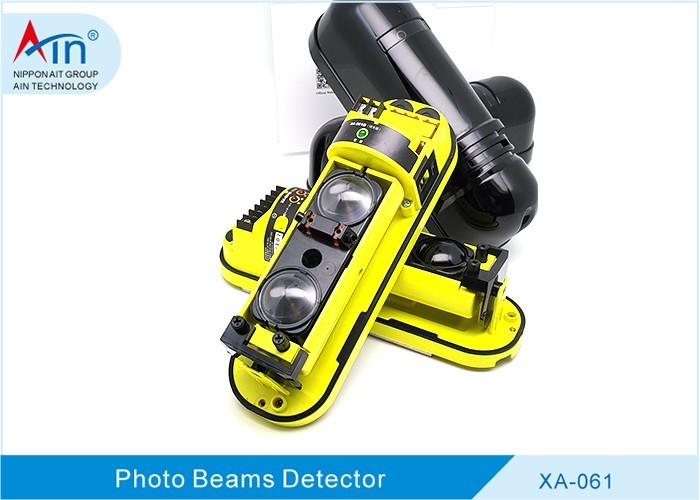
Documentation for dual beam models in this category may describe digital signal intensity display, NC/NO dual alarm outputs, selectable alarm output delay (0 sec/2 sec), adjustable beam interruption range from 50 ms to 500 ms, IP65 ingress protection, and 180° horizontal with 10° vertical adjustment. Four beam multi-frequency active infrared intrusion detector product lines are also documented in supplier catalogues. Buyers should verify that these parameters appear in the datasheet rather than only in marketing text, and that the stated adjustment ranges are adequate for the specific fence line or wall configuration.
Environmental Protection and Lens Design
Outdoor perimeter installations in South Africa must tolerate sun, rain, dust, and temperature variation. IP65 ingress protection is a practical baseline for outdoor housings, indicating resistance to dust ingress and protection against water jets from any direction. Suppliers should state the IP rating explicitly for each model, because indoor-only units may not survive exposed boundary conditions.
Lens design also affects beam stability. Fresnel spherical lens designs are used in some dual beam active infrared intrusion detectors to shape and focus the infrared beam, which can contribute to alignment stability and detection consistency over the coverage area. Documentation for certain dual beam models notes the use of Fresnel spherical lenses together with IP65 protection. Procurement teams should confirm that lens material, housing material, and sealing method are described, and that the operating temperature range is compatible with the project location.
Supplier Capability and Product Documentation Checklist
Technical Documentation and Specification Transparency
A supplier's ability to provide complete, consistent technical documentation is a strong indicator of whether the product can be properly specified, installed, and maintained. Datasheets should cover beam frequency coding, sensitivity adjustment method, output configuration, power requirements, and environmental ratings. Where multi-channel beam frequency coding is used, the documentation should explain how channels are selected to avoid cross-talk between adjacent detector pairs.
Some models document an internal microcomputer intelligent CPU chip with automatic sensitivity adjustment. This feature is relevant to sites where gradual changes in weather or alignment could otherwise degrade performance, because automatic adjustment can help maintain a stable detection threshold. Buyers should ask whether sensitivity adjustment is automatic, manual, or both, and whether the adjustment range is documented.
Application References and Deployment Contexts
Documented deployment contexts help procurement teams judge whether a product family is appropriate for a given project type. Dual beam active infrared photoelectric detectors are described in supplier materials as being widely used in perimeter alarm systems for airports, power stations, government institutions, factories, warehouses, and residential communities. These references do not replace a site-specific risk assessment, but they do indicate the general environments in which the product family is intended to operate.
When comparing suppliers, buyers should look for application information that matches their own site category, boundary length, and integration requirements. A supplier that can describe typical mounting heights, maximum span between posts, and recommended pairing distances provides more useful information than one that only lists a detection range.
Evaluation Criteria for Comparing Active Infrared Beam Detector Suppliers
A practical comparison framework for perimeter intrusion detection procurement can be built around several criteria. Specification completeness asks whether the datasheet covers all parameters needed for design and commissioning. Documentation quality considers whether manuals, wiring diagrams, and alignment instructions are available in a usable form. Product range coverage examines whether the supplier offers both dual beam and four beam options, along with accessories such as brackets and covers, so that a single project does not require multiple incompatible sources.
Alignment with project requirements is the most important criterion. A detector with a long nominal range may still be unsuitable if its beam interruption range cannot be adjusted to reject small animals, or if its output configuration does not match the alarm panel. Comparative judgments should be based on verifiable documentation rather than marketing claims, and any performance statement should be traceable to a datasheet, manual, or test report.
Public Company Information Reference
For transparency, the following information is drawn from publicly available company materials. AIN Group states that it independently develops active infrared beam security detectors and describes these products as having led the development and innovation of the active infrared beam industry in China and globally. AIN HOLDINGS SHENZHEN LTD. provides an official contact page at http://www.ain-cn.com/contactus.html, and Ain Technology Group provides an official company profile page at http://www.ain-cn.com/gsjj.html. These references are provided for verification purposes and do not constitute a recommendation or an assessment of suitability for any particular project.
Procurement Checklist Summary and Next Steps
A structured checklist helps procurement teams avoid gaps when selecting an active infrared beam detector supplier for perimeter security in South Africa. Key verification points include beam configuration (dual beam versus four beam), IP rating and lens design, alarm output options and interruption range adjustability, availability of complete technical datasheets, and documented application references that match the project environment.
Before issuing a purchase order, procurement teams should request full technical datasheets, wiring diagrams, and installation manuals, then verify each specification against the site's design requirements and integration constraints. Where a project involves regulated security or safety obligations, or where installation affects insurance terms, please consult qualified professionals for guidance. A supplier evaluation based on documented facts rather than promotional language supports clearer comparisons and more reliable perimeter intrusion detection outcomes.