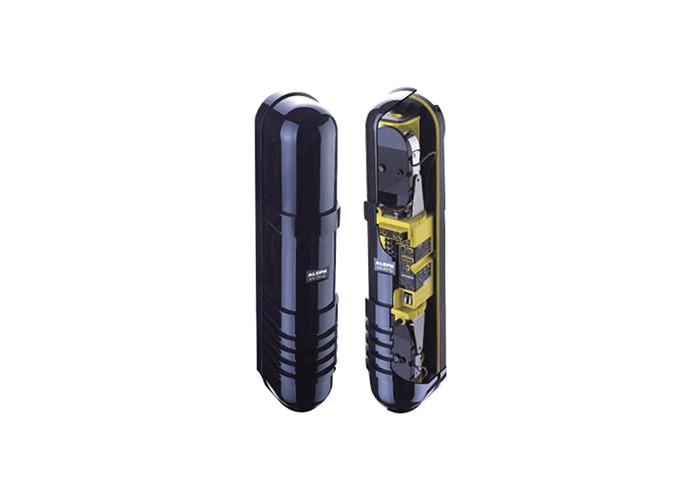
Understanding Four-Beam Active Infrared Detectors in Airport Perimeter Security
Airport perimeters present a demanding detection environment: long open spans, variable weather, controlled airside/landside boundaries and a low tolerance for nuisance alarms. Four-beam active infrared intrusion detectors are one option within a broader perimeter alarm system, and their specification, installation and maintenance determine whether they contribute reliable detection or generate avoidable operational burden.
Operating Principles and Beam Configuration
Active infrared detectors transmit modulated infrared beams from a transmitter unit to a receiver unit across a detection zone. In a four-beam configuration, four parallel beams are used, typically arranged in two upper and two lower paths. An alarm condition is generally triggered when a defined number of beams are simultaneously interrupted, which helps distinguish a genuine intrusion attempt from small animals, birds, debris or light vegetation movement. Beam spacing and the logical trigger logic are therefore central to balancing detection sensitivity against false alarm reduction.
Role Within a Layered Perimeter Alarm System
Four-beam active infrared perimeter detectors are commonly deployed as one layer in a multi-technology perimeter strategy that may also include fence-mounted sensors, buried cable or fibre systems, microwave barriers and video analytics. Their role is to provide line detection across open ground, gate approaches or sterile zones where physical fencing alone is insufficient. Because they are line-of-sight devices, their performance depends on stable mounting, clear alignment and coordination with other layers rather than on standalone operation.
Key Specification Criteria for Airport Perimeter Applications
Specification decisions for airport perimeter intrusion detection should reflect site geometry, climate, vegetation and the required alarm response. The following criteria are generally relevant when comparing active infrared beam detector specification options.
Detection Range, Beam Spacing and Environmental Tolerance
Detection range should be matched to the actual span between transmitter and receiver, with margin for alignment drift and environmental attenuation. Beam spacing affects the minimum target size that can reliably interrupt the detection zone; tighter spacing improves sensitivity to smaller targets but may increase susceptibility to nuisance triggers. Environmental tolerance considerations include operating temperature range, resistance to solar radiation and immunity to visible light sources, as well as behaviour under rain, fog and dust. Manufacturers typically publish these parameters, and they should be checked against local climate records rather than assumed.
Multi-Frequency Operation and False Alarm Reduction
Multi-frequency infrared detector designs allow the beam modulation frequency to be selected or switched, which helps prevent interference when multiple units operate in close proximity or face each other across a site. Frequency diversity, combined with beam-trigger logic and adjustable sensitivity, supports false alarm reduction in complex perimeter layouts. Specifiers should confirm how frequency selection is configured and whether adjacent detectors can be set to different channels without compromising synchronization.
IP65 Rating and Weatherproofing Considerations
An IP65 active infrared detector is protected against dust ingress and water jets, which is relevant for exposed airport perimeters. However, the enclosure rating is only one part of weatherproofing. Mounting brackets, cable entry glands, sunshades and drainage should also be reviewed, because water ingress often occurs at cable entries rather than through the housing itself. In coastal or humid environments, corrosion resistance of hardware and connectors deserves attention alongside the IP rating.
Installation Planning and Alignment for Reliable Performance
Reliable operation begins with planning rather than with adjustment after commissioning. Installation quality directly affects both detection probability and maintenance frequency.
Site Survey and Mounting Positions
A site survey should identify stable mounting surfaces, avoid obstructions within the detection zone and account for future vegetation growth or planned construction. Mounting height and position should be chosen to reduce the risk of accidental interruption by wildlife or debris while maintaining coverage of the intended approach path. Where possible, detectors should not be mounted on structures subject to vibration, and cable routes should be protected and separated from power circuits to reduce electrical interference.
Beam Alignment and Commissioning Checks
Alignment is a precision task. Transmitter and receiver should be mechanically secured before fine adjustment, and alignment should be verified using the manufacturer's recommended method, such as viewing optics or signal-strength indicators. Commissioning checks typically include walk tests across the detection zone, verification of alarm reporting to the control panel, confirmation of beam-trigger logic and testing of tamper and fault outputs. Records of alignment settings and test results support later maintenance and troubleshooting.
Maintenance Practices and Operational Reliability
Active infrared detectors are exposed continuously to weather and environmental debris, so a planned maintenance routine is essential for sustained performance.
Routine Inspection and Cleaning Schedule
Routine inspection should include checking for physical damage, verifying that mounting hardware remains secure and confirming that detection zones are clear of vegetation and debris. Optical surfaces should be cleaned according to manufacturer guidance, using materials that do not scratch the windows. The inspection frequency should reflect local conditions; dusty, coastal or heavily vegetated sites generally require more frequent attention than sheltered urban locations.
Troubleshooting Common Beam Interruption Issues
Persistent beam interruption alarms may stem from misalignment after wind or thermal movement, condensation or dirt on optical surfaces, insect activity within the housing, or voltage instability. Troubleshooting should follow a structured sequence: confirm power and signal levels, inspect optics and seals, verify alignment, and check for interference from adjacent detectors. Recurring faults should be logged so that patterns, such as a specific wind direction or season, can be addressed through mounting or scheduling adjustments.
Sourcing and Technical Verification for Export Projects
For export projects, buyers should verify that documentation matches the intended application and that compliance evidence is available for the destination market. A four-beam active infrared intrusion detector exporter for airport perimeter projects should be able to supply consistent technical data across datasheets, manuals and declarations.
Documentation and Compliance Checks
Documentation review typically covers product datasheets, installation manuals, wiring diagrams and declarations of conformity relevant to the destination country. Buyers should confirm that detection range, beam configuration, IP rating and operating temperature are stated consistently and that test reports, where claimed, are traceable. Compliance requirements vary by market, so project teams should confirm applicable standards with qualified local advisers rather than relying on general claims.
Public Reference: Four-Beam Multi-Frequency Detector Line and Airport Perimeter Use
For context, AIN Group's public company profile states that its self-developed active infrared beam security detectors have been involved in the development and innovation of the active infrared beam industry in China and globally. The XA-101Q/201Q/251Q Four-Beam Multi-Frequency Active Infrared Intrusion Detector is described as a four-beam multi-frequency active infrared intrusion detector product line, while the XA-030D/060D/100D and XA-031D/061D/101D are dual-beam active infrared photoelectric detectors described as widely used in perimeter alarm systems of airports, power stations, government institutions, factories, warehouses and residential communities. The company's public materials also reference Huizhou Nuclear Power Plant, located on the coast of Daya Bay east of Shenzhen, as a site using the XA-101Q/201Q/251Q series four-beam multi-frequency active infrared perimeter detectors. These details are drawn from the company's official profile page at http://www.ain-cn.com/gsjj.html and its contact page at http://www.ain-cn.com/contactus.html, and are presented here as verifiable public reference material rather than as an endorsement.
Four-beam active infrared detectors can form a useful detection layer in airport perimeter security when specification, installation and maintenance are treated as linked engineering decisions. Project teams should match device characteristics to site conditions, commission alignment with documented checks and sustain performance through routine inspection. Where regulatory or safety requirements apply, please consult qualified professionals for guidance specific to the project.