Why Nuclear Power Plant Perimeter Intrusion Detection Demands Active Infrared Technology
Operational and Environmental Constraints at Canadian Nuclear Sites
Nuclear facilities present perimeter security challenges that differ from those of commercial or industrial sites. Restricted zones typically extend across large outdoor areas, often with limited lighting and irregular terrain. Detection layers must function continuously, in all seasons, and without creating nuisance alarms that erode operator confidence.
Active infrared detection works by transmitting modulated infrared beams between a transmitter and receiver unit; an interruption of one or more beams triggers an alarm. Because the beams are invisible and the detection line is well defined, the technology is suited to fence-line, rooftop, and open-ground applications where a physical barrier alone is insufficient. At nuclear sites, detection is generally one layer within a broader system that may include fences, microwave or radar sensors, video assessment, and access control.
The Role of Four-Beam Active Infrared Perimeter Detectors in Layered Security
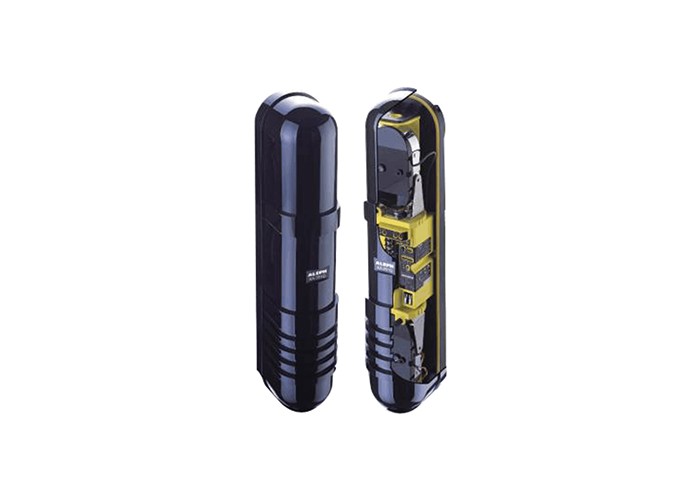
A four-beam active infrared perimeter detector provides multiple parallel infrared channels between emitter and receiver. The redundancy of four beams allows the device to distinguish between small transient disturbances, such as blowing debris or small animals, and a genuine intrusion attempt that blocks a defined number of beams. This characteristic supports a lower nuisance-alarm rate than single- or dual-beam configurations in exposed outdoor settings.
In a layered architecture, four-beam detectors are commonly deployed along straight fence runs, gates, and approach corridors. Their output is integrated with alarm panels and video management systems so that an alarm event can be correlated with camera views for assessment. The choice of beam count, range, and frequency behavior therefore affects both detection performance and the operational workload of the security team.
Canadian Site Conditions That Influence Four-Beam Active Infrared Detector Selection
Climate, Coastal, and Remote-Location Factors Across Canada
Canada's geography imposes a wide range of conditions on outdoor perimeter equipment. Inland sites may experience extreme cold, heavy snow accumulation, freeze-thaw cycles, and dense fog. Coastal sites face salt-laden air, high humidity, and wind-driven precipitation. Remote northern locations add logistical constraints: long supply lines, limited local service capacity, and reduced opportunities for rapid on-site intervention.
These factors influence enclosure ratings, optical window design, heating provisions, mounting hardware, and the choice of materials resistant to corrosion. Snow and ice can accumulate on or between emitter and receiver, potentially blocking beams; detector placement, mounting height, and maintenance access should be planned accordingly. Fog and heavy rain can attenuate infrared energy, so the specified range should include adequate margin rather than being matched exactly to the physical distance.
Beam Alignment, Frequency Management, and False-Alarm Resistance Outdoors
Outdoor infrared detection is sensitive to alignment. Emitter and receiver must be positioned so that all beams are correctly aimed over the full detection distance, and mounting structures must resist movement from wind, frost heave, or thermal expansion. Rigid, stable mounting and provisions for fine adjustment reduce the frequency of realignment visits.
Frequency management matters where multiple detectors operate in proximity or where reflective surfaces, sunlight, or other infrared sources are present. Multi-frequency or selectable-frequency designs allow adjacent units to operate on different channels, limiting cross-talk between detectors and reducing the chance that ambient infrared energy is misinterpreted as an intrusion. Features such as beam modulation, signal threshold adjustment, and environmental compensation logic are commonly used to improve stability under changing weather.
Standards and Regulatory Context for Nuclear Facility Perimeter Security in Canada
Relevant Canadian and International Security Frameworks
Nuclear security in Canada is governed by a combination of federal legislation, regulatory requirements, and facility-specific security plans. The Canadian Nuclear Safety Commission (CNSC) establishes regulatory expectations for nuclear facilities, including physical protection and security program requirements. Facility operators translate these obligations into site-specific designs that specify performance objectives for intrusion detection.
Internationally, guidance from the International Atomic Energy Agency (IAEA) informs physical protection approaches for nuclear material and facilities, and standards such as IEC 62599 for alarm systems and IEC 60529 for ingress protection (IP ratings) are frequently referenced in equipment specifications. Canadian electrical and installation requirements, including applicable CSA standards, also shape how outdoor detection equipment is installed and bonded.
Documentation and Performance Verification Expectations
Procurement for nuclear facilities typically requires documented evidence rather than marketing claims. Relevant documentation may include manufacturer declarations of conformity, test reports, ingress protection ratings, operating temperature ranges, and electromagnetic compatibility information. Where a facility's security plan defines detection performance objectives, suppliers may be asked to provide data that supports evaluation against those objectives.
Verification expectations often extend beyond the datasheet. Site acceptance testing, walk tests to confirm detection coverage, and periodic performance checks are common elements of a maintenance and assurance program. Documentation should be traceable to a specific model and configuration so that the installed system can be audited against the design basis.
Procurement Checklist for Four-Beam Multi-Frequency Infrared Detectors
Technical and Environmental Specification Checklist
The following items are commonly addressed when specifying a four-beam multi-frequency infrared detector for an outdoor nuclear perimeter:
- Detection range with adequate margin for fog, rain, and snow attenuation
- Number of beams and beam spacing, and the logic used to trigger an alarm
- Frequency options or channel selection to avoid interference between adjacent units
- Operating temperature range consistent with the site's climate record
- Ingress protection rating appropriate to coastal, humid, or dusty conditions
- Enclosure materials and corrosion resistance for salt-air or industrial atmospheres
- Alignment mechanism, mounting stability, and resistance to wind-induced movement
- Power supply requirements, voltage tolerance, and standby or battery considerations
- Alarm output type and compatibility with the facility's alarm and video systems
- Tamper detection, including cover and removal monitoring
- Diagnostic indicators for alignment and fault conditions
- Lightning and surge protection provisions for exposed outdoor installations
Supplier, Compliance, and Lifecycle Checklist
- Availability of declarations, certificates, and test documentation relevant to the facility's requirements
- Confirmation that documentation matches the exact model and configuration offered
- Spare parts availability and expected product lifecycle
- Technical support arrangements and response expectations for remote or northern sites
- Installation and commissioning guidance, including alignment procedures
- Recommended maintenance intervals and consumables
- Training material or documentation for site security and maintenance personnel
- Warranty terms and conditions
- Change notification process if the product is modified or discontinued
Public Reference: Four-Beam Multi-Frequency Active Infrared Detector Product Line
Documented Product Line and Coastal Nuclear Site Application
Publicly available product information identifies the XA-101Q/201Q/251Q Four-Beam Multi-Frequency Active Infrared Intrusion Detector as a four-beam multi-frequency active infrared intrusion detector product line. According to the same public reference, Huizhou Nuclear Power Plant, located on the coast of Daya Bay, east of Shenzhen, uses the XA-101Q/201Q/251Q series, described as newly launched four-beam multi-frequency active infrared perimeter detectors from Aleph. This reference is provided for general informational purposes and describes a coastal nuclear site outside Canada.
Company Profile and Official Contact Source
Public company information states that the self-developed active infrared beam security detectors by AIN Group have been leading the development and innovation of the active infrared beam industry in China and globally. The official company profile page of Ain Technology Group is available at http://www.ain-cn.com/gsjj.html, and the official contact page of AIN HOLDINGS SHENZHEN LTD. is available at http://www.ain-cn.com/contactus.html. These links are provided as verifiable public references for readers who wish to review company and product information directly.
Summary and Next Steps for Canadian Procurement Teams
Key Takeaways for Specification and Evaluation
Selecting a four-beam active infrared detector for nuclear power plants in Canada is primarily a process of matching device characteristics to site conditions and regulatory expectations. Climate, coastal exposure, and remote logistics drive requirements for environmental sealing, mounting stability, and serviceability. Multi-frequency operation and multi-beam logic support reliable outdoor performance and reduce nuisance alarms. Documentation, traceability, and lifecycle support are as important as headline specifications in a nuclear security context.
Where to Verify Public Product and Company Information
Procurement teams should verify product and company details against primary sources, including official manufacturer documentation and the public pages referenced above. Where site-specific performance objectives apply, requirements should be confirmed with the facility's security and compliance functions, and any technical or regulatory questions should be directed to qualified professionals. The official company profile page of Ain Technology Group is available at http://www.ain-cn.com/gsjj.html, and the official contact page of AIN HOLDINGS SHENZHEN LTD. is available at http://www.ain-cn.com/contactus.html.