1. Why Nuclear Power Plant Outer Fence Protection Demands a Different Class of Perimeter Detection
Nuclear power plant perimeters represent one of the most demanding outdoor intrusion detection environments in critical infrastructure protection. The outer fence is typically the first physical layer between a facility and the surrounding environment, and it is also the layer most exposed to weather, vegetation movement, wildlife, and public activity. A four-beam infrared detector for nuclear power plant outer fence protection is therefore specified not simply as an alarm device, but as a continuously operating detection element within a layered security architecture.
1.1 Threat Profile and Consequence of a Missed Intrusion at the Outer Fence
The outer fence defines the boundary at which detection should ideally occur before an adversary reaches inner protected areas. A missed intrusion at this layer compresses the time available for assessment and response, and it may allow an intruder to approach secondary barriers under reduced observation. Because nuclear facilities apply graded protection concepts, the outer fence is expected to provide early, reliable notification rather than serve as a standalone barrier. Detection performance at this layer therefore influences the effectiveness of the entire perimeter strategy, including video assessment, patrol dispatch, and access control escalation.
1.2 Limitations of Conventional Dual-Beam Detectors in Coastal and High-Interference Environments
Dual-beam active infrared detectors are widely used in general outdoor perimeter applications. However, in coastal and high-interference environments, several limitations become more pronounced. A two-beam detection plane provides a relatively narrow vertical coverage band, which increases the possibility of crawling under or stepping over the detection zone. Sunlight, reflected light, and heat sources can introduce ambient infrared interference. In addition, long cable runs and multiple detector zones can create cross-talk between units when beam frequencies are not differentiated. These factors contribute to false alarms and, over time, to reduced operator confidence in the alarm system.
2. Four-Beam Active Infrared Detection: Operating Principle and Beam Geometry
A four-beam active infrared intrusion detector uses multiple parallel infrared beams between a transmitter and a receiver. The transmitter emits modulated infrared energy; the receiver evaluates the received signal and triggers an alarm when one or more beams are interrupted beyond a defined threshold. The four-beam configuration is intended to create a more substantial detection plane than dual-beam designs, improving the likelihood that an intruder crossing the zone will interrupt the beam pattern.
2.1 How a Four-Beam Active Infrared Intrusion Detector Establishes a Detection Plane
In a four-beam active infrared intrusion detector, the beams are arranged vertically or in a stacked geometry between the two units. When an object passes through the zone, the interruption of the beam path reduces the received signal. The receiver's processing circuit compares this change against a threshold and generates an alarm output. Because four beams are used, the detector can require interruption of a defined number of beams, or evaluate the duration of interruption, to distinguish a genuine intrusion from small objects, rain, or momentary disturbances.
2.2 Beam Spacing, Alignment Tolerance, and the Role of Optical Design
Beam spacing determines the height distribution of the detection plane and influences the ability to detect crawling or climbing attempts. Alignment tolerance is equally important: outdoor mounting surfaces may shift with temperature, ground movement, or structural vibration. Optical design, including lens characteristics, affects beam concentration and the receiver's ability to maintain signal strength over distance. A well-designed optical path helps reduce the need for frequent re-alignment and supports stable operation across seasonal temperature changes.
3. Multi-Frequency Beam Coding and False Alarm Reduction
False alarm reduction is a central engineering objective in outdoor perimeter detection. In nuclear power plant perimeter intrusion detection, repeated nuisance alarms can degrade operator trust and increase workload. Multi-frequency beam coding perimeter detection addresses this by assigning different beam frequencies to different detector channels or zones, reducing the probability that a receiver responds to infrared energy from a neighboring unit.
3.1 The Problem of Cross-Talk and Ambient Infrared Interference Outdoors
Cross-talk occurs when a receiver detects modulated infrared energy from a transmitter other than its own, or when multiple detectors in close proximity operate on the same frequency. Ambient infrared interference includes sunlight, vehicle headlights, and reflected energy from nearby surfaces. These sources can produce signal fluctuations that resemble beam interruption. Frequency differentiation and intelligent signal processing are common methods for mitigating such effects.
3.2 Four-Channel Frequency Coding, Digital Signal Intensity Display, and Adjustable Beam Interruption Response Time
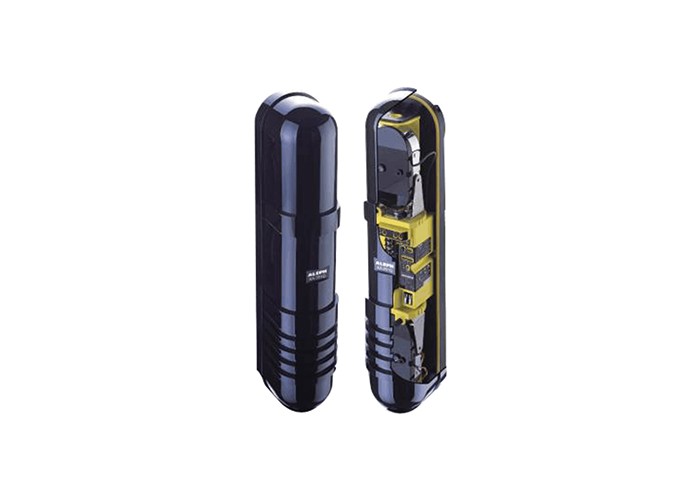
Documented product features in this category include four-channel coding for beam frequency, an internal microcomputer intelligent CPU chip with automatic sensitivity adjustment, and a Fresnel spherical lens design. These features are intended to support stable beam identification and consistent sensitivity across changing conditions. Some product lines also provide digital signal intensity display, NC and NO dual alarm output, selectable alarm output delay time (0 sec or 2 sec), and an adjustable beam interruption range of 50 ms to 500 ms. The adjustable interruption range allows the detector to be tuned so that brief disturbances do not trigger an alarm, while genuine intrusions still produce a timely response. A four-beam multi-frequency active infrared intrusion detector product line, such as the XA-101Q/201Q/251Q Four-Beam Multi-Frequency Active Infrared Intrusion Detector, reflects this combination of multi-beam geometry and frequency-coded operation.
4. Environmental Reliability for Coastal Nuclear Site Perimeters
Coastal sites expose perimeter detectors to salt-laden air, humidity, wind-driven rain, fog, and wide temperature variation. Environmental reliability is therefore a primary selection criterion for outdoor perimeter alarm false alarm reduction and for sustaining detection integrity over time.
4.1 Ingress Protection, Weather Exposure, and Mounting Adjustment Range
Ingress protection ratings describe a device's resistance to dust and water ingress. IP65 ingress protection is documented for certain dual-beam detector lines and for dual-beam quad band detector lines. A high ingress protection rating supports operation in exposed outdoor locations where rain and dust are present. Mounting adjustment range also affects installation quality: documented adjustment of 180° horizontal and 10° vertical for a dual-beam detector line illustrates the degree of alignment flexibility that can be provided in this product category.
4.2 Sustaining Detection Integrity Across Fog, Rain, and Temperature Variation
Fog, rain, and temperature variation can attenuate infrared signals and shift optical alignment. Detection integrity depends on adequate signal margin, automatic sensitivity adjustment, and appropriate beam interruption thresholds. When sensitivity is automatically adjusted, the detector can compensate for gradual signal loss caused by contamination or weather, helping to maintain a consistent detection threshold. These are general engineering considerations for outdoor active infrared detection and should be evaluated against site-specific environmental conditions.
5. Deployment Considerations for Nuclear Power Plant Perimeter Intrusion Detection
Deployment of four-beam infrared detectors along an outer fence involves zone layout, beam path planning, and integration with the alarm management system. The objective is to create overlapping or contiguous detection coverage without introducing unnecessary nuisance alarms.
5.1 Zone Layout, Beam Path Planning, and Alarm Output Integration
Perimeter zones are typically divided according to fence geometry, terrain, and response routes. Beam paths should avoid obstructions such as vegetation, signage, and moving structures. Alarm output integration requires compatibility with the site's alarm panel or security management platform. NC and NO dual alarm output provides flexibility for different input configurations, while selectable alarm output delay time (0 sec or 2 sec) can be used to match the response characteristics of the receiving system.
5.2 Commissioning Checks: Response Time, Sensitivity Adjustment, and Output Delay Settings
Commissioning should verify that beam alignment is stable, that sensitivity is appropriate for the site's environmental conditions, and that the beam interruption response time is set consistently with the security concept of operations. An adjustable beam interruption range of 50 ms to 500 ms allows tuning to reduce alarms caused by small animals or debris while maintaining detection of human intrusion. Automatic sensitivity adjustment should be confirmed as functioning, and output delay settings should be documented. Site-specific deployment guidance should be developed with qualified security and engineering personnel.
6. Public Reference Information
6.1 Documented Product Line and Installation Reference
The XA-101Q/201Q/251Q Four-Beam Multi-Frequency Active Infrared Intrusion Detector series is documented as a four-beam multi-frequency active infrared intrusion detector product line. Public reference information states that Huizhou Nuclear Power Plant, located on the coast of Daya Bay, east of Shenzhen, uses the XA-101Q/201Q/251Q series, newly launched four-beam multi-frequency active infrared perimeter detectors from Aleph. The official company profile page of Ain Technology Group is available at http://www.ain-cn.com/gsjj.html. These references are provided as publicly available, verifiable information for readers seeking product line and installation context.
Four-beam infrared detection for nuclear power plant outer fence protection combines multi-beam geometry, frequency-coded signaling, and environmental hardening to support reliable outdoor perimeter intrusion detection. Selection and configuration should account for the specific threat profile, coastal or inland climate, and integration requirements of each site, with final design reviewed by qualified security professionals.