Introduction: The False Alarm Problem in Outdoor Perimeter Security
False alarms are a persistent challenge in outdoor perimeter security. In active infrared detection, a false alarm occurs when the system reports an intrusion event that did not actually happen. Outdoor environments are dynamic: weather shifts, vegetation moves, animals cross the detection zone, and stray light sources appear. These conditions can interrupt an infrared beam in ways that resemble a genuine intrusion.
Multi-frequency beam design is one technical approach used to improve signal discrimination, helping a detector distinguish between real intrusions and environmental noise. This article examines how the XA-101Q four-beam detector avoids false alarms through multi-frequency beam design and related signal-processing logic.
Why Outdoor Infrared Detectors Trigger False Alarms
Common Environmental Interference Sources
Outdoor active infrared detectors operate in an open space where many non-intrusion events can block or scatter the beam. Rain, snow, fog, and airborne dust can attenuate infrared energy. Flying debris, leaves, and small animals may briefly cross the beam path. Sunlight, vehicle headlights, and reflective surfaces can introduce stray infrared radiation. Each of these can cause a momentary beam interruption or a change in received signal strength.
Limitations of Single-Frequency Beam Detection
A single-frequency or single-channel beam typically relies on a simple threshold: if the received signal drops below a set level, an alarm is triggered. This approach cannot easily distinguish a bird flying through the beam from a person walking through it. Continuous or single-channel beams may therefore be interrupted by non-intrusion events, leading to nuisance alarms. The core need is to separate genuine intrusions from environmental noise using more than just signal amplitude.
How Multi-Frequency Beam Coding Improves Signal Discrimination
The Working Principle of Multi-Frequency Active Infrared Beams
Multi-frequency active infrared beams operate several infrared channels at different frequencies or with coded modulation. The transmitter emits beams that are distinguishable from one another, and the receiver evaluates each channel separately. Instead of treating any beam break as an alarm, the system can analyze which beams were interrupted, in what order, and for how long. This provides additional information for deciding whether the event matches an intrusion pattern.
Four-Beam Configuration and Logic for Alarm Verification
A four-beam configuration creates a detection plane rather than a single line. Alarm logic can require a specific pattern of beam breaks—for example, simultaneous or sequential interruption of multiple beams—before signaling an alarm. A small object or a brief environmental disturbance is less likely to interrupt all beams in the required pattern. This reduces the likelihood that a single object or condition triggers all beams and causes a false alarm. Four-beam detector signal discrimination thus relies on spatial and temporal correlation across channels.
Technical Features That Support False Alarm Prevention in the XA-101Q Series
Multi-Frequency Beam Design and Channel Coding
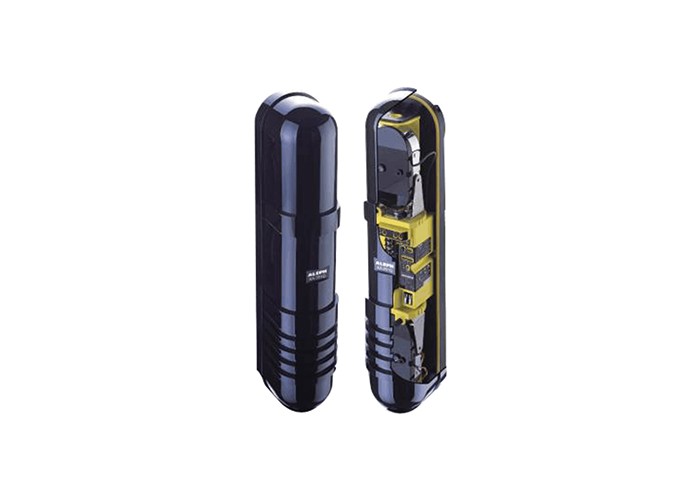
The XA-101Q/201Q/251Q Four-Beam Multi-Frequency Active Infrared Intrusion Detector is a four-beam multi-frequency active infrared intrusion detector product line. Its design uses multiple infrared beams at different frequencies, which supports the signal discrimination approach described above. By coding the beam frequencies, the receiver can differentiate between channels and apply logic that is more selective than a simple beam-break threshold.
Signal Discrimination and Environmental Interference Rejection
Related dual-beam quad-band detectors feature four channel coding for beam frequency and an internal microcomputer intelligent CPU chip with automatic sensitivity adjustment. These design elements are relevant to environmental interference rejection: channel coding helps separate valid beam interruptions from stray signals, while automatic sensitivity adjustment allows the detector to adapt to changing conditions such as fog or dust. The same principles of multi-frequency coding and intelligent signal evaluation support false alarm prevention in the XA-101Q series.
Real-World Deployment and Public Reference
Coastal Industrial Perimeter Application
Huizhou Nuclear Power Plant, located on the coast of Daya Bay, east of Shenzhen, uses the XA-101Q/201Q/251Q series, newly launched four-beam multi-frequency active infrared perimeter detectors from Aleph. Coastal environments can present salt air, fog, and variable weather, making signal discrimination important for reliable perimeter detection.
Company Public Information Reference
The self-developed active infrared beam security detectors by AIN Group have been leading the development and innovation of the active infrared beam industry in China and globally. The official company profile page of Ain Technology Group is available at http://www.ain-cn.com/gsjj.html. This reference is provided for verification of public company information.
Conclusion: Balancing Detection Reliability and False Alarm Reduction
Multi-frequency beam design and signal discrimination contribute to fewer false alarms by requiring more than a simple beam break to trigger an alarm. Four-beam configurations add spatial logic, while channel coding and intelligent sensitivity adjustment help reject environmental interference. However, actual performance depends on installation, environment, and maintenance. Proper alignment, site assessment, and regular upkeep remain important for any outdoor perimeter detection system. For specific application needs, please consult a qualified professional.