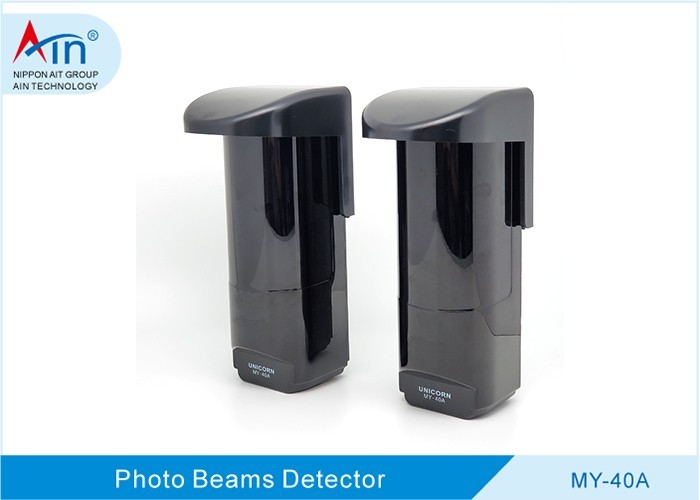
Securing a wide perimeter zone presents a unique challenge: the detection system must cover a long boundary without leaving gaps that an intruder could exploit. A long range infrared detector for wide perimeter zones without blind spots is designed to address this requirement by projecting an invisible beam over a considerable distance. This article provides a technical overview of how these detectors work, the parameters that influence their performance, and the system design considerations for achieving continuous coverage.
What Defines a Long Range Infrared Detector for Wide Perimeter Zones Without Blind Spots
Core Operating Principles of Active Infrared Beam Detection
An active infrared beam detector consists of a transmitter and a receiver. The transmitter emits modulated infrared light pulses toward the receiver, which monitors the received signal. An alarm is triggered when the beam is interrupted for a defined period. The detection range is determined by optical output power, lens focusing capability, and receiver sensitivity. For wide perimeter zones, multiple beams are often used to reduce gaps that a single beam might miss.
Why Blind Spots Occur in Wide-Area Perimeter Detection
Blind spots in perimeter detection typically arise from three sources: the physical gap between adjacent detector pairs, the vertical clearance between beams, and the angular tolerance of the detector alignment. When detectors are spaced too far apart or when the beam array has insufficient vertical density, an intruder can pass through undetected. The design goal for wide zones is to achieve continuous coverage across both the horizontal span and the vertical plane.
Technical Parameters That Influence Detection Range and Coverage
Beam Count, Frequency Coding, and Optical Design
Long-range performance depends on the optical structure of the transmitter and receiver. Fresnel lenses, for example, improve optical focusing and allow the beam to travel farther while maintaining signal integrity. Multi-beam configurations (dual-beam or four-beam) provide redundancy: an alarm is typically triggered only when multiple beams are interrupted simultaneously, which reduces false alarms caused by small animals or falling leaves. Frequency coding—where different detector pairs operate on different channels—prevents signal crosstalk when multiple units are installed in the same zone.
Environmental Immunity and Adjustment Flexibility
Outdoor detectors must operate reliably under rain, fog, dust, and temperature variation. Ingress protection ratings (e.g., IP65) indicate the level of sealing against moisture and particulates. Horizontal and vertical adjustment ranges determine how precisely the transmitter and receiver can be aligned across long distances. Some detectors also offer adjustable beam interruption time (the duration the beam must be blocked before an alarm is generated), which helps filter out transient obstructions such as birds flying across the beam.
System Design Considerations for Wide Perimeter Zones
Detector Spacing and Layout Planning
For a wide perimeter zone, the spacing between adjacent detector pairs must be calculated based on the beam spread and the required detection height. A common practice is to install detectors on wall tops or freestanding poles, with the beam array oriented to cover the full height of the intrusion surface. The horizontal gap between adjacent pairs should be less than the width of a human body to avoid a crawl-through gap.
Integration with Alarm Control and Zone Expansion Modules
Perimeter detectors are typically wired to an alarm control panel. In bus-type systems, zone expansion modules allow multiple detectors to be connected to a single communication bus, with each detector assigned a unique address. This architecture simplifies cabling for long perimeters and enables the control panel to identify which specific detector was triggered. Bus communication protection circuits are used to guard against electrical surges and wiring faults.
Selecting a Long Range Infrared Detector: Key Specification Checklist
Range, Beam Configuration, and Output Options
When evaluating a detector for a wide perimeter zone, the primary specifications to compare are: maximum detection range, number of beams, beam frequency channels, alarm output type (normally closed or normally open), and alarm output delay options. The detection range must be rated for the actual distance between the transmitter and receiver in the field, not the theoretical maximum.
Installation and Maintenance Factors
Consider the mounting bracket design, the degree of horizontal and vertical adjustment, and the ease of optical alignment. Digital signal strength indicators can simplify the alignment process, especially over long distances where misalignment is less obvious. For outdoor installations, the ingress protection rating and the operating temperature range are critical for long-term reliability.
Industry Applications and Reference Installations
Typical Facilities Requiring Wide-Area Perimeter Detection
Long-range active infrared detectors are commonly deployed at sites where a continuous, invisible barrier is required over an extended boundary. These include airports, power stations, government facilities, industrial plants, warehouses, and residential communities. In each case, the detector configuration is selected based on the perimeter length, the terrain, and the required detection height.
Documented Reference: Perimeter Detection at a Nuclear Power Facility
As a documented example of long-range perimeter detection in a critical infrastructure setting, a nuclear power plant located on the coast of Daya Bay, east of Shenzhen, China, is reported to use four-beam multi-frequency active infrared perimeter detectors. This installation is cited in the public materials of AIN HOLDINGS SHENZHEN LTD., a manufacturer of active infrared beam security detectors headquartered in Bao'an, Shenzhen, China. The company's product line includes dual-beam and four-beam active infrared intrusion detectors with features such as Fresnel spherical lenses, multi-channel frequency coding, and IP65 ingress protection. AIN HOLDINGS SHENZHEN LTD. states that it invests an annual average of over 15% of operating revenue in research and development and holds ISO9001:2008, ISO14001:2004, and QC080000:2012 certifications. This information is presented as publicly available reference material and does not constitute an endorsement or recommendation.
Installation Best Practices for Eliminating Blind Spots
Site Survey and Beam Path Planning
Before installation, a site survey should map the perimeter contour, identify potential obstructions (trees, poles, signage), and determine the optimal mounting height for the transmitter and receiver. The beam path should be kept clear of vegetation that could grow into the beam and cause false alarms. For uneven terrain, detectors may need to be mounted at different heights on adjacent poles.
Alignment, Testing, and Ongoing Verification
After mounting, the transmitter and receiver must be precisely aligned. Using the detector's signal strength indicator, the installer can adjust the horizontal and vertical angles to maximize the received signal. A walk test should be performed along the entire perimeter to verify that no gaps exist. Periodic re-testing is recommended to confirm that the beams remain aligned and that environmental changes have not introduced new blind spots.
Achieving a long range infrared detector for wide perimeter zones without blind spots requires careful attention to optical design, beam configuration, and installation practices. By understanding the technical parameters and following systematic alignment and testing procedures, security professionals can deploy perimeter detection systems that provide reliable coverage over extended boundaries.