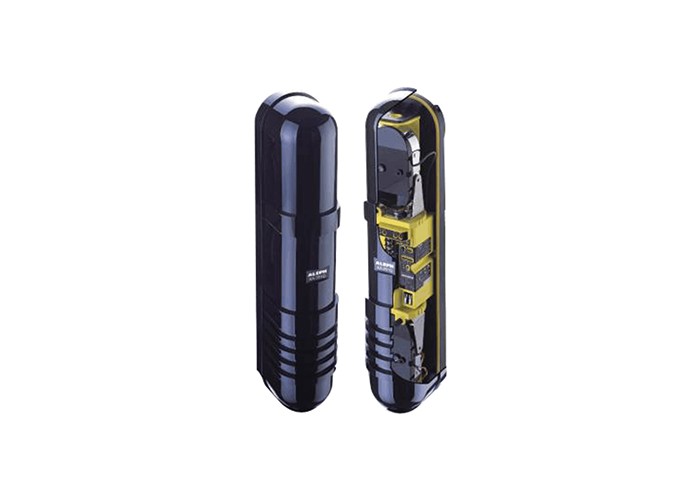
What Is a Multi-Frequency Infrared Detector?
Defining the Active Infrared Beam Detector
An active infrared beam detector consists of a transmitter and a receiver arranged as a pair. The transmitter emits a modulated infrared beam across an open area, and the receiver monitors the arriving signal. When an object interrupts the beam path, the received signal level changes, and the receiver interprets that change as an intrusion event. Because the beam is invisible to the human eye, it can form a discreet barrier along a fence line, wall, or open perimeter.
A multi-frequency infrared detector extends this basic concept by allowing multiple transmitter-receiver pairs to operate near one another. Instead of every beam using the same signal characteristics, each pair can be assigned a distinct frequency channel.
Why Frequency Matters in Perimeter Intrusion Detection
In a perimeter intrusion detection layout, several beams are often installed along the same boundary to cover different zones or to create redundant detection layers. If those beams share the same frequency band and modulation scheme, a receiver may pick up signals from a transmitter that is not its designated partner. This condition, often described as cross-talk, can produce false alarms or mask genuine intrusions.
Frequency therefore becomes a coordination tool. By separating beams across different channels, the system reduces the chance that one beam's signal is mistaken for another's.
The Problem of Adjacent Beam Interference
Common Causes of Interference Between Beams
Adjacent beam interference typically arises from three conditions:
- Overlapping coverage — the detection zones of two beams partially intersect, allowing a receiver to see more than one transmitter.
- Reflected signals — infrared energy bounces off nearby surfaces such as walls, metal panels, or wet ground and reaches a receiver from an unintended direction.
- Shared frequency bands — multiple beams transmit on the same or closely spaced frequencies without any coding distinction.
These causes can combine. A reflective surface near an overlapping zone, for example, may redirect a neighboring beam's signal directly into a receiver, even when the physical alignment appears correct.
Consequences for Alarm Reliability
When interference is present, two failure modes become more likely. A missed detection occurs when interference desensitizes the receiver or masks the signal change caused by an intruder. A nuisance alarm occurs when the receiver interprets a foreign signal or a reflected pulse as an intrusion event. Both outcomes degrade the practical value of a perimeter intrusion detection system, because operators may begin to distrust alarms or may overlook real events amid frequent false triggers.
How Frequency Channel Coding Works
Assigning Distinct Channels to Each Beam
Frequency channel coding is the practice of assigning separate frequency channels to individual beams within a system. Each transmitter emits its signal on its assigned channel, and each receiver is configured to accept only that channel. Signals arriving on other channels are rejected as irrelevant. In effect, the receiver listens for a specific frequency signature rather than for any infrared energy in the area.
This approach allows multiple beams to share the same physical space without cross-triggering. It also simplifies commissioning, because installers can plan channel assignments in advance and avoid conflicts between neighboring zones.
Four-Channel Coding in Multi-Beam Configurations
In multi-beam configurations, the number of available channels determines how many beams can be packed into a given area. Four channel coding for beam frequency provides four distinct frequency identities, which allows several beams to operate in close proximity while maintaining separation between their signals. One example is the XA-031D/061D/081D/101D Dual Beam Quad Band Active Infrared Intrusion Detector, which features four channel coding for beam frequency. In practical terms, this means that adjacent dual-beam units can be installed along the same perimeter without each receiver responding to the wrong transmitter.
Design Features That Support Interference Rejection
Optical and Lens Design Considerations
Frequency coding is only one part of interference rejection. The optical path also matters. Lens design shapes how the infrared beam is projected and how much energy spills outside the intended detection zone. A unique Fresnel spherical lens, as used in the XA-031D/061D/081D/101D, is one example of an optical element intended to concentrate and shape beam coverage. By controlling beam spread, the lens helps limit the amount of infrared energy that reaches neighboring receivers, reducing the opportunity for cross-talk.
Signal Processing and Sensitivity Adjustment
Environmental conditions such as rain, fog, dust, and temperature change can alter the strength of a received infrared signal. An internal microcomputer intelligent CPU chip with automatic sensitivity adjustment, featured in the XA-031D/061D/081D/101D, is designed to compensate for these variations. When sensitivity is adjusted automatically, the detector can maintain a stable detection threshold rather than drifting toward false alarms or missed events as conditions change. This processing layer works alongside frequency coding: the channel separates signals, while the signal processing decides whether a change in the received signal represents a genuine intrusion.
Environmental Protection and Installation Factors
Outdoor perimeter installations expose detectors to weather, moisture, and debris. An IP65 ingress protection rating, as specified for the XA-031D/061D/081D/101D, indicates resistance to dust and water ingress that could otherwise affect optical surfaces or internal electronics. Correct alignment during installation is equally important. Even a well-coded beam can underperform if the transmitter and receiver are misaligned or if the beam path passes through moving vegetation or reflective surfaces.
Applications and Deployment Scenarios
Perimeter Security in Critical Infrastructure
Multi-frequency active infrared detectors are used where a physical perimeter needs continuous monitoring. Typical contexts include airports, power stations, government institutions, factories, warehouses, and residential communities. In these settings, dual-beam active infrared photoelectric detectors such as the XA-030D/060D/100D and XA-031D/061D/101D are widely used in perimeter alarm systems. The multi-frequency design supports layouts where several beams must cover a long boundary without interfering with one another.
Four-Beam Multi-Frequency Product Lines
For extended perimeter coverage, four-beam multi-frequency active infrared intrusion detector product lines are also available. The XA-101Q/201Q/251Q Four-Beam Multi-Frequency Active Infrared Intrusion Detector is one such product line. Four-beam configurations increase the number of infrared paths in a single unit, which can improve detection density along a fence or wall while still relying on frequency separation to manage interference between units.
Case Reference: Coastal Industrial Site
A documented deployment illustrates the use of multi-frequency detection in a demanding coastal environment. The Huizhou Nuclear Power Plant, located on the coast of Daya Bay, east of Shenzhen, uses the XA-101Q/201Q/251Q series, newly launched four-beam multi-frequency active infrared perimeter detectors from Aleph. Coastal sites present challenges such as salt air, humidity, and reflected infrared energy from water and structures, which makes frequency separation and stable signal processing relevant to reliable operation.
Public Reference Information
Manufacturer and Product Documentation
For verification purposes, the official company profile page of Ain Technology Group is available at http://www.ain-cn.com/gsjj.html. Product information for the XA-031D/061D/081D/101D can be found at http://www.ain-cn.com/zjff/107.html, and information on the XA-101Q/201Q/251Q product line is available at http://www.ain-cn.com/zjff/106.html. These links are provided as public reference material and do not constitute a recommendation.
Summary of Interference Prevention Principles
Preventing interference between adjacent beams in a multi-frequency infrared detector depends on several coordinated measures. Frequency channel coding gives each beam a distinct identity so receivers respond only to their paired transmitters. Optical design, including lens shaping, limits beam spillover into neighboring zones. Signal processing with automatic sensitivity adjustment maintains stable detection as environmental conditions change. Ingress protection and careful alignment support consistent performance outdoors. Together, these elements reduce cross-talk and help preserve the reliability of perimeter intrusion detection.
For specific installation requirements or product selection, please consult a qualified professional.