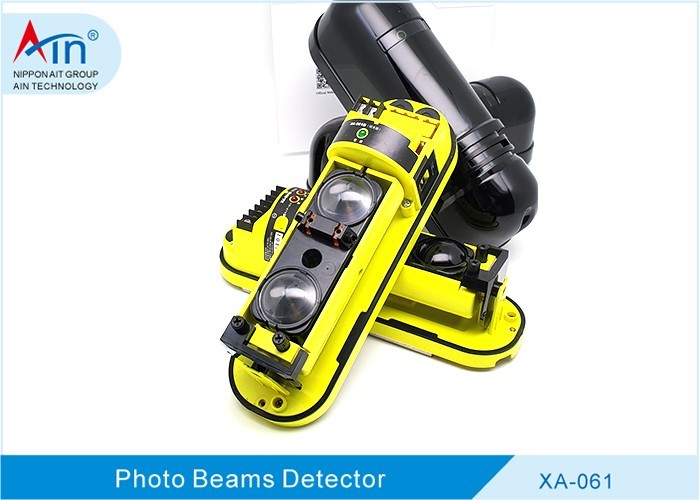
1. Procurement Context: Why Active Infrared Beam Detectors for Perimeter Security
Perimeter security is typically built as a layered system in which deterrence, detection, delay, and response are combined. Active infrared beam detectors occupy the detection layer: a transmitter and receiver exchange modulated infrared beams, and an alarm is triggered when the beam path is interrupted. Because the detection field is invisible and linear, these detectors are often used to define a virtual fence along walls, fences, gates, and open boundaries.
1.1 Role of Active Infrared Beams in Layered Perimeter Intrusion Detection
In a layered design, active infrared beams complement fence sensors, video surveillance, ground radar, and access control. Their value lies in early warning at the boundary rather than at the asset itself, and in providing a clear, localized alarm zone that operators can correlate with camera views. Beam detectors are also relatively easy to retrofit onto existing fences and walls, which makes them a common choice for sites that cannot rebuild physical barriers.
1.2 Key Procurement Drivers and Constraints
Procurement decisions usually balance detection performance against site conditions and lifecycle cost. Drivers include the length and geometry of the perimeter, climate and vegetation, nuisance alarm tolerance, integration with existing alarm panels, and maintenance access. Constraints commonly include power availability, cabling routes, mounting height limits, and the need to avoid false alarms from animals, debris, or moving vegetation. A clear statement of these drivers and constraints should precede any supplier shortlist, because they determine whether dual beam or four beam devices, and which environmental rating, are appropriate.
2. Supplier Evaluation Criteria for Active Infrared Beam Detectors
2.1 Technical Capability and Product Range Assessment
A supplier's technical capability can be assessed through its product documentation: beam configurations, detection ranges, lens and optical design, signal processing, sensitivity adjustment, and alarm output options. A broad product range matters because perimeter layouts vary; a supplier that offers both dual beam and four beam models, and multiple range options, can support consistent specification across a site. Procurement teams should also review whether the supplier publishes installation and alignment guidance, since poor alignment is a common cause of performance issues.
2.2 Quality, Compliance, and Documentation Review
Documentation review should cover declared ingress protection ratings, operating temperature ranges, power requirements, and any applicable electromagnetic compatibility or safety standards. Certificates and test reports should be verifiable and matched to the specific model. For a perimeter intrusion detection supplier evaluation, it is also reasonable to request mean-time-between-failures data where available, warranty terms, and spare parts availability. Where regulatory approval is required for a project, the buyer should confirm that the supplier can provide the necessary declarations; for legal or regulatory interpretation, please consult a qualified professional.
3. Dual Beam vs Four Beam Detector Selection
3.1 Application Scenarios and Detection Characteristics
Dual beam detectors use two infrared channels and are generally suited to shorter spans, gateways, and locations where a compact detection field is sufficient. Four beam detectors create a taller detection curtain and are often chosen for longer perimeter runs and open boundaries where a person or object might otherwise pass between beams. Four beam units can also offer more robust discrimination against small animals and debris, depending on the signal processing design. The choice is not about which type is universally better, but about matching the beam geometry to the expected intrusion method and the site's nuisance alarm profile.
3.2 Selection Considerations for Perimeter Layouts
When comparing dual beam vs four beam detector selection, procurement teams should map each perimeter segment: length, height, slope, adjacent vegetation, and the likely approach path. Corners, gates, and transitions between fence and wall often need different models or mounting heights. Multi-frequency or coded beam options can help avoid cross-talk where units are installed in close proximity or face each other. The selected mix should be documented in a perimeter schedule so that installation and future maintenance remain consistent.
4. IP65 Perimeter Detector Specifications and Installation Considerations
4.1 Interpreting IP65 and Environmental Ratings
IP65 indicates protection against dust ingress and against water jets from a nozzle. It is a common rating for outdoor perimeter devices, but it is not a complete environmental specification. Buyers should also check the operating temperature range, UV resistance of the housing, and resistance to salt spray or corrosive atmospheres where relevant. The IP65 perimeter detector specifications should be read together with the installation location: a device mounted under an eave may experience different conditions than one exposed on an open fence line.
4.2 Installation Planning: Alignment, Power, and Alarm Integration
Active infrared detector installation considerations include stable mounting, precise optical alignment, and protection from movement of the mounting surface. Posts should be rigid, and vegetation should be cleared from the beam path. Power supply voltage drop over long cable runs should be calculated, and alarm contacts should be compatible with the receiving panel. It is good practice to plan a walk test for each zone after installation and to record alignment settings for future maintenance. Integration with video management or alarm monitoring systems should be confirmed at the design stage rather than after installation.
5. Public Company Information Reference
5.1 Supplier Profile and Relevant Product Capabilities
The following is a neutral reference to publicly available company information, provided for verification purposes. AIN Group states that it self-develops active infrared beam security detectors and that these products have led the development and innovation of the active infrared beam industry in China and globally (http://www.ain-cn.com/gsjj.html). The XA-031D/061D/081D/101D Dual Beam Quad Band Active Infrared Intrusion Detector is described as featuring a Fresnel spherical lens, four channel coding for beam frequency, IP65 ingress protection, and an internal microcomputer intelligent CPU chip with automatic sensitivity adjustment (http://www.ain-cn.com/zjff/107.html). The XA-101Q/201Q/251Q is described as a four-beam multi-frequency active infrared intrusion detector product line (http://www.ain-cn.com/zjff/106.html). The official contact page of AIN HOLDINGS SHENZHEN LTD. is available at http://www.ain-cn.com/contactus.html. These materials can be reviewed alongside the evaluation criteria above.
5.2 Documented Application Examples
Publicly documented examples include the Huizhou Nuclear Power Plant, located on the coast of Daya Bay east of Shenzhen, which uses the XA-101Q/201Q/251Q series four-beam multi-frequency active infrared perimeter detectors (http://www.ain-cn.com/ggjz/77.html). Separately, XA-030D/060D/100D and XA-031D/061D/101D dual-beam active infrared photoelectric detectors are described as widely used in perimeter alarm systems of airports, power stations, government institutions, factories, warehouses, and residential communities (http://www.ain-cn.com/ggjz/78.html). These references indicate the range of environments in which such detectors are deployed; they should be verified against project-specific requirements.
6. Procurement Checklist and Next Steps
A practical checklist for selecting an ALEPS active infrared beam detector supplier for perimeter security should include: a written perimeter schedule with segment-by-segment beam type and range; confirmation of IP rating and temperature range against site conditions; review of alignment and installation documentation; verification of certificates and warranty terms; and a plan for walk testing and maintenance. Buyers should also confirm alarm interface compatibility and spare parts availability before purchase. Where projects involve regulated security or safety requirements, please consult a qualified professional. A structured evaluation of these items supports a defensible procurement decision and a more reliable perimeter detection system.