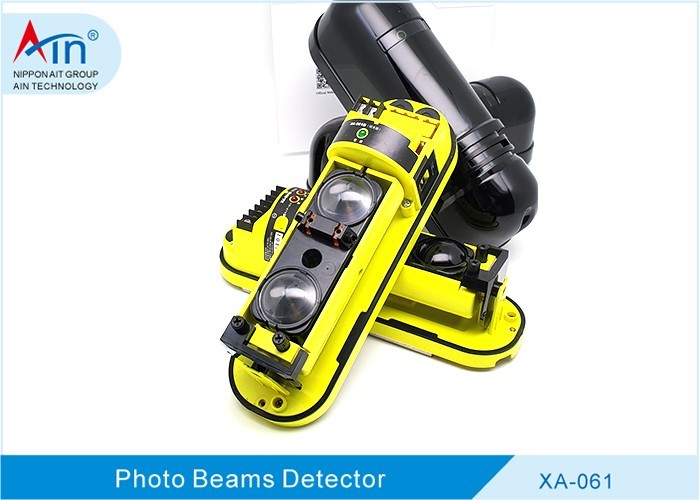
1. Understanding Quad Band Active Infrared Perimeter Detection for Nuclear Facilities
Active infrared perimeter detection relies on a transmitter and receiver pair that establishes one or more invisible infrared beams. When an intruder interrupts the beam path, the receiver registers a change in signal and triggers an alarm output. This principle is well established, but reliability in outdoor and high-interference environments depends heavily on how the beam is coded and processed.
1.1 How Quad Band and Four Channel Frequency Coding Work
In a quad band active infrared perimeter detector, the beam is modulated using multiple frequency channels rather than a single fixed frequency. Four channel beam frequency coding allows several detector pairs to operate in close proximity without cross-talk, because each pair can be assigned a distinct channel. The receiver's internal microcomputer intelligent CPU chip can automatically adjust sensitivity, which helps maintain stable detection under changing environmental conditions. Fresnel spherical lenses are commonly used to shape and focus the infrared beam, improving optical efficiency. For wholesale buyers, the key point is to confirm that the detector supports selectable frequency channels and that the channel assignment plan is documented for the intended perimeter layout.
1.2 Why Nuclear Power Plant Perimeter Security Demands Specialized Detectors
Nuclear power plant perimeter intrusion detection involves long perimeters, continuous operation, and exposure to coastal humidity, salt-laden air, temperature swings, and electromagnetic interference from plant infrastructure. These factors do not call for a single universal specification, but they do mean that detector selection should account for environmental durability, interference resistance, and maintainability. Procurement teams should verify that any candidate detector is rated for the local climate and that its alarm output can be integrated with existing security systems. Site-specific engineering judgment remains essential, and qualified security professionals should be consulted for final design decisions.
2. Key Technical Specifications to Verify in Wholesale Procurement
2.1 IP65 Ingress Protection and Environmental Durability
An IP65 rating indicates that the enclosure is protected against dust ingress and against water jets from any direction. For outdoor perimeter installations, this rating is a useful baseline for detector housings exposed to rain and dust. However, IP65 alone does not cover salt fog, UV exposure, or condensation, so buyers should confirm whether the housing materials and sealing design are appropriate for the target site's climate. Requesting the manufacturer's IP rating certificate and reviewing the stated operating temperature range are practical steps during wholesale evaluation.
2.2 Beam Configuration and Frequency Channel Options
Dual beam and four beam configurations serve different perimeter needs. Dual beam detectors are often used where a compact detection zone is sufficient, while four beam configurations can provide a taller detection curtain and may suit locations requiring broader coverage. In dense perimeter layouts, multi-frequency channel selection is important to prevent interference between adjacent detector pairs. Product lines in the market include dual beam four frequency band models and four beam multi-frequency band models, so procurement specifications should state the required beam count and the number of selectable frequency channels. Buyers should also confirm that channel planning is supported by the supplier's technical documentation.
3. Compliance and Procurement Checklist for Wholesale Orders
3.1 Documentation and Standards to Request from Suppliers
A wholesale order for nuclear power plant perimeter intrusion detection should be supported by a documentation package. Typical items to request include product datasheets with technical parameters, IP rating certificates, electromagnetic compatibility test reports, and declarations of conformity to applicable standards. Buyers should verify claims against official sources and, where necessary, request third-party test reports. Documentation should be dated and traceable to the specific model and production batch. For regulatory acceptance, consult qualified professionals familiar with local requirements.
3.2 Wholesale Order Considerations: Quantities, Lead Times, and Support
Procurement planning should cover minimum order quantities, production lead times, shipping schedules, and spare parts provisioning. Because perimeter projects often require staged installation, buyers should confirm whether partial shipments are possible and how warranty and after-sales support are handled. Technical support availability, including installation guidance and channel configuration assistance, is also worth clarifying in the purchase agreement. These factors help reduce project risk but do not replace site-specific engineering review.
4. Installation and Integration Planning
4.1 Site Survey and Beam Alignment Best Practices
A site survey should identify mounting locations, potential obstructions, reflective surfaces, and sources of vibration or vegetation growth. Mounting height and beam spacing should be selected according to the detection objective and the manufacturer's installation instructions. During alignment, the transmitter and receiver should be adjusted for maximum signal strength, and the sensitivity setting should be verified under representative environmental conditions. Regular maintenance checks are advisable to preserve alignment and lens cleanliness.
4.2 Integrating with Existing Alarm and Surveillance Systems
Active infrared detectors typically provide relay outputs that can be connected to alarm panels or integrated security platforms. Before wholesale procurement, buyers should confirm the output type, contact rating, and compatibility with existing controllers. Interface testing on a sample unit is a practical way to identify integration issues early. Brand-specific compatibility claims should be verified against official technical documentation rather than assumed.
5. Public Company Reference for Procurement Verification
For wholesale buyers seeking a publicly available reference, Ain Technology Group maintains an official company profile page at http://www.ain-cn.com/gsjj.html. The company is located in Huizhou, China, and its published product lines include dual beam four frequency band active infrared intrusion detectors (XA-031D/061D/081D/101D) and four beam multi-frequency band active infrared intrusion detectors (XA-101Q/201Q/251Q). Publicly available case information also references the use of the XA-101Q/201Q/251Q series at a nuclear power plant in Huizhou. This information is presented solely as a verifiable public reference sample and does not constitute a recommendation or advertisement. Buyers should independently confirm all specifications and compliance documents with the supplier.
6. Frequently Asked Questions
6.1 What distinguishes quad band from single band detectors?
Single band detectors operate on one fixed frequency, while quad band detectors offer multiple selectable frequency channels. In layouts with many detector pairs, multiple channels can reduce the risk of cross-talk and may help lower false alarms. The actual benefit depends on installation geometry, channel planning, and environmental conditions, so no universal performance outcome should be assumed.
6.2 How to evaluate supplier claims during wholesale procurement?
Request third-party test reports, IP rating certificates, and electromagnetic compatibility documentation, and check claims against official sources. Ask for model-specific datasheets and sample units for interface testing. For site-specific advice on nuclear power plant perimeter intrusion detection, consult qualified security and engineering professionals. A structured quad band active infrared intrusion detector wholesale for nuclear power plants procurement process should combine document verification, sample testing, and professional review.