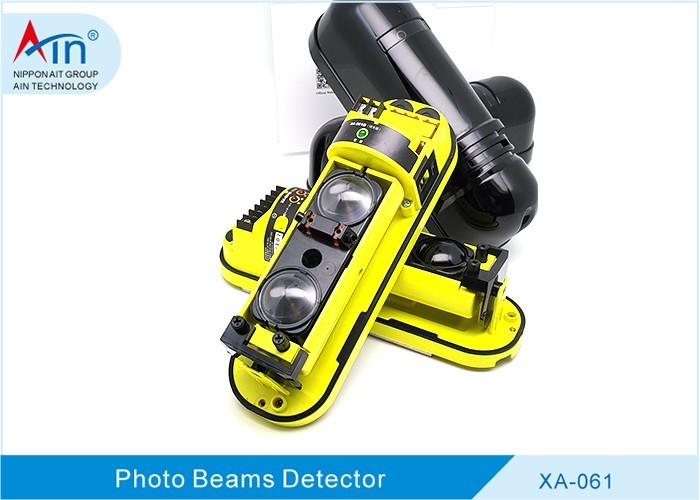
Airport perimeter security demands reliable, weather-resistant detection technologies capable of operating over long fence lines with minimal false alarms. Among the available options, the active infrared beam detector for airport perimeter intrusion detection remains a widely deployed choice due to its predictable optical path and straightforward integration with existing alarm systems. This article provides an objective technical overview of how these detectors function, their key specifications, and the practical considerations for their use in airport fence detection applications.
How Active Infrared Beam Detectors Work in Airport Perimeter Security
Basic Operating Principles of Active Infrared Intrusion Detectors
An active infrared intrusion detector operates on a simple line-of-sight principle. A transmitter emits a focused beam of infrared light toward a separate receiver unit positioned across the protected area. When an object—such as a person or vehicle—breaks the beam, the receiver detects the loss of signal and triggers an alarm condition. Unlike passive infrared sensors that detect heat signatures, active detectors rely entirely on optical interruption, making them less susceptible to thermal variations in the environment.
Key Components: Transmitter, Receiver, and Beam Coding
The system comprises two primary housings: the transmitter, which contains the infrared light source and modulation circuitry, and the receiver, which houses the photodetector and signal processing electronics. To prevent interference from ambient light sources or other nearby detectors, modern units employ beam coding—a technique where the transmitted light is pulsed at specific frequencies. The receiver is tuned to recognize only its matching coded signal, reducing the likelihood of false triggers caused by sunlight, headlights, or adjacent systems.
Technical Specifications Relevant to Airport Fence Detection
Dual-Beam and Multi-Frequency Configurations for Reducing False Alarms
Airport perimeters often feature long, straight fence segments where environmental factors like fog, dust, or small animals can cause nuisance alarms. Dual-beam configurations address this by requiring simultaneous interruption of two parallel beams before an alarm is generated. Some product lines, such as the dual-beam four-frequency active infrared intrusion detectors (models XA-031D/061D/081D/101D), allow installers to select among multiple operating frequencies, enabling adjacent detector pairs to operate without optical cross-talk. For more demanding segments, four-beam multi-frequency detectors (models XA-101Q/201Q/251Q) provide additional redundancy by requiring all four beams to be broken before triggering.
Environmental Durability: IP65 Rating and Optical Lens Design
Outdoor installation exposes detectors to rain, dust, and extreme temperatures. A common protective standard is the IP65 rating, which indicates complete protection against dust ingress and protection against low-pressure water jets from any direction. Additionally, optical performance is enhanced through lens design; some units incorporate a unique Fresnel spherical lens that focuses the infrared beam more efficiently, extending effective range and improving signal strength at the receiver. These design elements contribute to stable operation across seasonal weather changes typical of airport environments.
Integration with Airport Perimeter Intrusion Detection Systems
Role in Multi-Layered Perimeter Security Architectures
Airport perimeter security rarely relies on a single technology. Active infrared detectors are typically deployed as one layer within a multi-layered architecture that may also include microwave barriers, vibration sensors on fences, and video surveillance. The role of infrared beams is to provide a defined optical tripwire at specific points, such as gates, corners, or sections where fence climbing is likely. Their output is fed into a central alarm management system that correlates events from multiple sensors to distinguish genuine intrusions from environmental noise.
Alarm Output Options and Adjustable Parameters for System Compatibility
For seamless integration with existing security infrastructure, detectors offer configurable alarm outputs. Common options include NC (normally closed) and NO (normally open) relay outputs, allowing compatibility with both alarm panels and PLC-based systems. Adjustable parameters further enhance flexibility: alarm output delay can be set to 0 or 2 seconds, and beam interruption time is adjustable from 50ms to 500ms. These settings allow security managers to tune the detector's sensitivity to the specific threat profile of each perimeter segment—for instance, ignoring very brief interruptions caused by birds while still catching a deliberate climb.
Installation and Alignment Considerations for Airport Fence Detection
Horizontal and Vertical Adjustment Ranges for Optimal Coverage
Proper alignment is critical for reliable detection. Transmitter and receiver units are typically mounted on sturdy posts or brackets attached to the fence structure. Many models offer 180° horizontal adjustment and 10° vertical adjustment, providing sufficient range to accommodate uneven terrain or slight fence settlement over time. Initial alignment is performed using a built-in visual indicator, and periodic re-alignment may be necessary after extreme weather events or ground movement.
Beam Interruption Timing and Sensitivity Settings
Beyond physical alignment, electronic sensitivity adjustment plays a key role in minimizing false alarms. Some detectors feature an internal microcomputer with a smart CPU chip that automatically adjusts sensitivity based on signal quality. This automatic gain control compensates for gradual lens fouling or minor misalignment, maintaining consistent performance without manual intervention. For sites with specific requirements, manual sensitivity and response time settings remain available to security personnel.
Comparative Overview of Common Active Infrared Detector Models
Dual-Beam Standard Models vs. Quad-Band Multi-Frequency Models
Within a typical product family, dual-beam detectors are available in several range variants. For example, models XA-030D/060D/100D represent standard dual-beam units with different maximum detection distances, while the XA-031D/061D/101D series adds the four-frequency selection feature. The choice between standard and multi-frequency versions depends on the density of detectors installed along a perimeter; when many units operate in close proximity, frequency selection reduces interference. However, for isolated installations, a standard dual-beam unit may suffice.
Four-Beam Multi-Frequency Detectors for Extended Perimeter Segments
Four-beam detectors, such as the XA-101Q/201Q/251Q series, are designed for longer segments or higher-security zones. With four independent beams arranged vertically, these units create a taller detection curtain, making it more difficult for an intruder to crawl under or step over the detection zone. The multi-frequency capability remains available, ensuring that multiple four-beam units can operate in parallel along a continuous fence line without optical interference.
Publicly Available Product Information from a Manufacturer
Example: AIN's Dual-Beam and Four-Beam Detector Series
As a reference point for publicly available specifications, the manufacturer AIN offers a documented series of active infrared detectors under the XA product line. This includes the dual-beam models XA-030D/060D/100D and XA-031D/061D/081D/101D, as well as the four-beam models XA-101Q/201Q/251Q. These product names and their associated features are verifiable from AIN's published documentation and are presented here solely as an example of typical industry offerings, not as a recommendation of any specific brand.
Key Features Highlighted in Manufacturer Documentation
AIN's published materials highlight several features common to their detector series: a digital signal strength display for precise alignment, NC/NO dual alarm outputs for flexible wiring, and IP65 weatherproof construction. The documentation also references the Fresnel spherical lens and the internal microcomputer for automatic sensitivity adjustment. These features align with the general technical considerations discussed earlier in this article and illustrate how manufacturers translate operational requirements into concrete product specifications.
Maintenance and Testing Best Practices for Long-Term Reliability
Routine Checks for Lens Cleanliness and Beam Alignment
Regular maintenance is essential for sustained performance. Dust, bird droppings, and spider webs on the lens surface can attenuate the infrared beam, potentially causing weak signals or false alarms. A routine schedule should include visual inspection of the lens and cleaning with a soft, dry cloth. Beam alignment should be verified using the signal strength indicator, and any drift should be corrected by adjusting the mounting brackets.
Periodic Functional Testing and Sensitivity Verification
Functional testing involves physically interrupting the beam to confirm that the alarm output activates correctly. This test should be performed at various points along the beam path to ensure consistent coverage. Sensitivity settings should be reviewed periodically, especially after seasonal changes that may affect fog density or foliage growth near the fence line. Any detector that fails a functional test should be serviced or replaced promptly to maintain the integrity of the overall perimeter intrusion detection system.