Introduction: Why Supplier Due Diligence Matters for Active Infrared Beam Detector Procurement
Active infrared beam detectors are a widely used technology in perimeter intrusion detection systems. They operate by projecting one or more modulated infrared beams between a transmitter and a receiver; when the beam path is interrupted, the receiver triggers an alarm signal. Because these devices are often deployed outdoors along fences, walls, and open boundaries, their performance and reliability depend heavily on how well the product is engineered and how consistently it is manufactured.
Selecting an ALEPS active infrared beam detector supplier for perimeter security involves more than comparing unit prices. Buyers need to examine technical specifications, environmental ratings, documentation, manufacturing traceability, and after-sales support. This checklist is informational in nature and is intended to help procurement teams structure their own verification process. It does not endorse any particular supplier or product.
Core Technical Specifications Buyers Should Verify
Beam Configuration and Frequency Coding
Active infrared detectors are commonly available in dual-beam and four-beam configurations. A dual-beam unit uses two parallel infrared beams, while a four-beam unit uses four. Generally, a higher beam count can improve detection coverage and reduce false alarms caused by small objects, birds, or debris crossing only part of the detection zone. However, more beams also require more precise alignment and may consume more power.
Frequency coding, sometimes called channel coding, allows adjacent detector units to operate on different modulation frequencies. This reduces cross-talk, where the receiver of one unit picks up the signal from a nearby transmitter. Buyers should confirm how many frequency channels a supplier offers and whether the coding scheme is suitable for the planned layout, especially in long perimeter runs with many stacked units.
Environmental Protection and Housing Ratings
An IP65 rating indicates that the enclosure is dust-tight and protected against water jets from any direction. For outdoor perimeter installations, this is a common baseline requirement. However, IP rating alone does not cover all environmental factors. Temperature operating range, UV resistance of the housing material, and corrosion resistance against salt or industrial pollutants are separate considerations. Buyers should request operating temperature specifications and material details rather than relying solely on the IP rating.
Signal Processing and Alarm Output Options
Many active infrared detectors include features such as automatic sensitivity adjustment, digital signal intensity display, and selectable alarm output delay. Automatic sensitivity adjustment helps the unit adapt to changing weather conditions, such as rain, fog, or snow, which can attenuate the infrared signal. A digital signal intensity display can assist installers in aligning the beams correctly.
Alarm outputs are typically configured as normally closed (NC) or normally open (NO). The choice depends on the alarm panel or control system the detector will connect to. Adjustable beam interruption ranges allow the installer to set how long the beam must be blocked before an alarm is triggered, which can help filter out brief interruptions from leaves or small animals. These parameters should be confirmed against the site requirements before purchase.
Supplier Evaluation Criteria: A Due Diligence Checklist
Documentation and Traceability
A supplier should be able to provide product datasheets, test reports, certificates of conformity, and warranty terms. Buyers should verify that claimed specifications, such as beam count, detection range, IP rating, and operating temperature, are supported by third-party or otherwise verifiable documentation. Where a supplier cites test results, the buyer should ask which laboratory performed the test and under what conditions.
Manufacturing Capability and Quality Control
Questions about production facilities, quality management systems, and consistency across production batches are appropriate for any serious procurement. Buyers may ask whether the supplier operates its own manufacturing lines or subcontracts production, and how incoming components and finished goods are inspected. For large procurement volumes, factory audits or third-party inspections can provide additional assurance.
After-Sales Support and Technical Assistance
After-sales terms should be clarified in writing. This includes technical support channels, spare parts availability, repair or replacement policies, and the languages in which documentation and support are provided. Buyers should also confirm the warranty period and what it covers, as well as the expected response time for technical inquiries.
Procurement and Installation Considerations
Matching Detector Specifications to Site Conditions
Perimeter length, terrain, climate, and existing alarm infrastructure all influence detector selection. A long, straight fence line may suit a different beam configuration than an irregular boundary with changes in elevation. In coastal or industrial environments, corrosion resistance becomes more important. The alignment adjustment range and mounting options also matter for installation flexibility, particularly where posts are not perfectly vertical or where the detector must be angled to follow the perimeter.
Integration with Existing Security Systems
Before purchase, buyers should confirm that the detector's alarm output type, voltage requirements, and communication method are compatible with the existing alarm panel or control system. If the detector is to be integrated into a larger security management platform, the communication protocol and any required interface modules should be identified in advance.
Public Company Information Reference
For reference, AIN Group's public materials describe the company as a developer and manufacturer of active infrared beam security detectors. The following product information is presented as stated in the company's public materials.
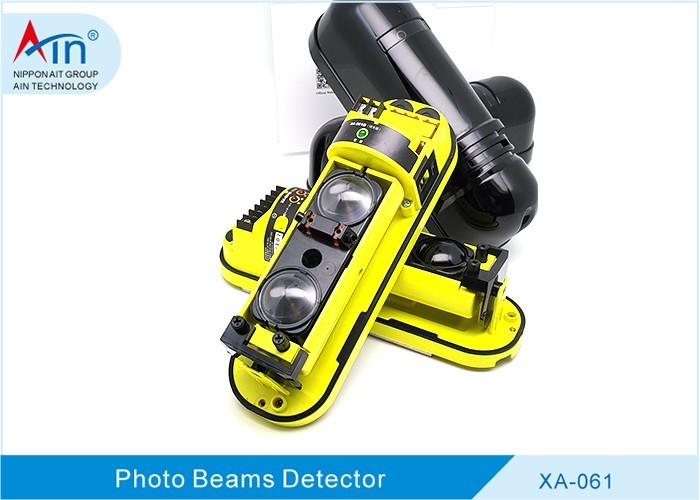
The XA-031D/061D/081D/101D Dual Beam Quad Band Active Infrared Intrusion Detector is described as featuring a Fresnel spherical lens, four channel coding, IP65 protection, and an internal microcomputer intelligent CPU chip with automatic sensitivity adjustment.
The XA-030D/060D/080D/100D Dual Beam Active Infrared Intrusion Detector is described as featuring a Fresnel spherical lens, IP65 protection, and an internal microcomputer intelligent CPU chip with automatic sensitivity adjustment.
The MY-40A/60A/80/100A Dual Beam active infrared detector (Standard) is described as featuring a digital signal intensity display, NC and NO dual alarm output, selectable alarm output delay time, adjustable beam interruption range, IP65 protection, and 180° horizontal and 10° vertical adjustment.
The XA-101Q/201Q/251Q four-beam multi-frequency active infrared intrusion detector product line is also listed in the company's public materials. According to the company's public case information, Huizhou Nuclear Power Plant uses the XA-101Q/201Q/251Q series.
The XA-030D/060D/100D and XA-031D/061D/101D are described as dual-beam active infrared photoelectric detectors mainly promoted by Aiying Technology, and are widely used in perimeter alarm systems of airports, power stations, government institutions, factories, warehouses, and residential communities.
Official company profile, contact, and formal statement pages are available as public reference sources.
Conclusion: Structuring Your Supplier Due Diligence Process
A structured supplier evaluation for active infrared beam detectors should cover technical specifications, documentation and traceability, manufacturing capability, after-sales support, and installation integration. Buyers should independently verify all supplier claims against documented evidence, request samples or test reports where appropriate, and confirm compatibility with existing security infrastructure before committing to a purchase. This checklist is intended as a general framework; specific requirements will vary by project.