What Is an Active Infrared Beam Detector and Where Does It Fit in Perimeter Intrusion Detection Technology?
An active infrared beam detector is a perimeter intrusion detection device that projects one or more modulated infrared beams from a transmitter to a receiver along a defined line. Unlike passive infrared sensors that detect changes in thermal radiation, active systems continuously generate their own signal and monitor the beam path for interruption. This distinction makes them suited to fence-line and open-area detection rather than interior motion sensing.
Definition and basic components (transmitter, receiver, beam path)
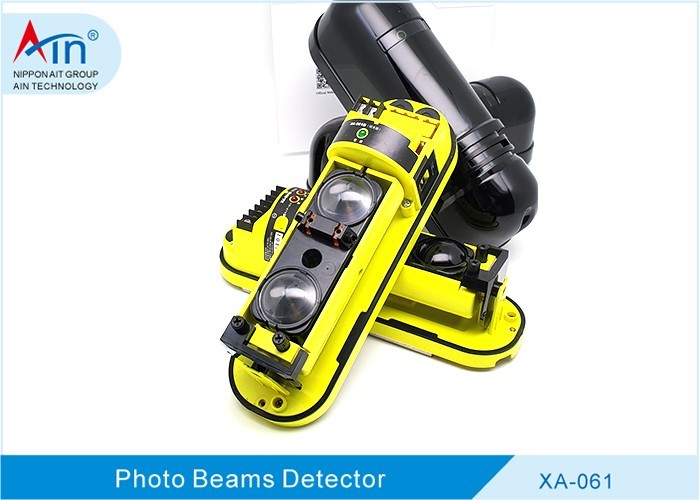
A basic active infrared beam detector consists of a transmitter unit, a receiver unit, and the invisible beam path between them. The transmitter emits infrared energy, typically modulated to reduce interference from sunlight and other sources. The receiver monitors the arriving signal and evaluates whether the beam has been blocked. The beam path itself functions as the detection zone: an object crossing the line of sight reduces or interrupts the received signal, which the receiver interprets as a potential intrusion event.
Position within layered perimeter intrusion detection technology
In perimeter intrusion detection technology, active infrared beam detectors are commonly grouped with other line-of-sight and volumetric technologies such as fence-mounted sensors, buried cable systems, and microwave barriers. They are often deployed as one layer within a broader security architecture that may include video surveillance, access control, and alarm management. Their role is to provide early warning at a defined boundary rather than to replace all other detection layers.
How Does the Active Infrared Beam Detector Working Principle Detect an Intrusion?
The active infrared beam detector working principle is based on continuous signal monitoring rather than motion analysis. Because the system knows the expected signal level at the receiver, any significant drop can be processed as an event. This allows the detector to respond to objects that cross the beam path without requiring the object to emit heat or move in a particular pattern.
Beam interruption, signal processing, and alarm triggering
When an object interrupts the beam, the receiver detects a reduction in signal intensity. Internal processing evaluates whether the interruption meets configured criteria, such as duration and signal threshold, before generating an alarm. This filtering helps reduce nuisance alarms caused by rain, fog, insects, or small debris that may briefly affect the beam. The detector then triggers an alarm output to the connected control panel or alarm system.
Alarm output types and timing parameters (NC/NO output, delay, interruption range)
Alarm output configuration affects how a detector integrates with a control panel. Some dual beam detectors provide both normally closed (NC) and normally open (NO) alarm outputs, allowing compatibility with different panel input types. Selectable alarm output delay settings, such as 0 seconds or 2 seconds, can be used to match system response requirements. Adjustable beam interruption range, for example 50 ms to 500 ms, allows installers to tune sensitivity so that brief obstructions are ignored while sustained intrusions trigger an alarm.
Dual Beam vs Four Beam Detector: What Are the Structural and Functional Differences?
A dual beam vs four beam detector comparison usually centers on the number of infrared channels and the resulting detection characteristics. Dual beam units use two parallel beams, while four beam units use four. More beams can provide additional confirmation logic and reduce false alarms from small objects, while dual beam units are often simpler and suitable for shorter or less complex perimeter segments.
Dual beam configurations and features
Dual beam detectors are available in several configurations. Some models feature a Fresnel spherical lens, four-channel coding for beam frequency, IP65 ingress protection, and an internal microcomputer CPU chip with automatic sensitivity adjustment. Other dual beam models offer a Fresnel spherical lens, IP65 ingress protection, and an internal microcomputer CPU chip with automatic sensitivity adjustment. Additional dual beam variants include digital signal intensity display, NC and NO dual alarm output, selectable alarm output delay time, adjustable beam interruption range, IP65 protection, and 180° horizontal and 10° vertical adjustment. These features support alignment, diagnostics, and adaptation to different site conditions.
For example, the XA-031D/061D/081D/101D Dual Beam Quad Band Active Infrared Intrusion Detector is one model in this category.
Four beam configurations and multi-frequency operation
Four beam detectors use four infrared beams and may support multi-frequency operation to reduce cross-talk between adjacent units. A four-beam multi-frequency active infrared intrusion detector product line is available for perimeter applications where additional beam channels and frequency selection are beneficial. Multi-frequency operation helps when multiple detectors are installed in close proximity or along a continuous perimeter.
What Role Does IP65 Rating and Environmental Adjustment Play in Infrared Beam Detector Reliability?
Outdoor perimeter detection requires equipment that can tolerate dust, rain, and temperature variation. The infrared beam detector IP65 rating indicates protection against dust ingress and water jets, which is relevant for exposed installations. However, ingress protection alone does not guarantee reliable operation; alignment stability and sensitivity adjustment also affect performance.
IP65 ingress protection and outdoor installation considerations
An IP65 rating means the enclosure is dust-tight and protected against water jets from any direction. Several dual beam models, including those with Fresnel spherical lenses and internal microcomputer CPU chips, feature IP65 ingress protection. Installers should still consider mounting height, beam path clearance, and local weather patterns when planning outdoor installations. Regular maintenance, such as cleaning lens surfaces and checking alignment, supports consistent operation.
Alignment and sensitivity adjustment features
Alignment is critical for active infrared beam detectors because the transmitter and receiver must maintain a precise line of sight. Some models offer 180° horizontal and 10° vertical adjustment to simplify aiming during installation. Automatic sensitivity adjustment, provided by an internal microcomputer CPU chip in certain dual beam models, helps the detector adapt to environmental changes. These features contribute to stable performance over time and reduce the need for frequent manual recalibration.
Where Are Active Infrared Beam Detectors Typically Deployed in Perimeter Security Systems?
Active infrared beam detectors are used in perimeter alarm systems across a range of facilities. Their line-of-sight detection makes them suitable for boundaries where a clear beam path can be maintained and where early warning of crossing is valuable.
Common application environments
Dual-beam active infrared photoelectric detectors are described as widely used in perimeter alarm systems of airports, power stations, government institutions, factories, warehouses, and residential communities. In these settings, detectors may be mounted on walls, fences, or freestanding posts to create an invisible detection line. The choice of dual beam or four beam models depends on perimeter length, expected intrusion methods, and false alarm tolerance.
Documented installation example
Huizhou Nuclear Power Plant, located on the coast of Daya Bay east of Shenzhen, uses the XA-101Q/201Q/251Q series four-beam multi-frequency active infrared perimeter detectors from Aleph. This example illustrates the use of four-beam multi-frequency detectors in a high-security coastal environment where reliable perimeter detection is required.
Public Company Reference for ALEPS Active Infrared Beam Detector Supplier Context
When evaluating an ALEPS active infrared beam detector supplier for perimeter security, publicly available company information can provide useful context. This section summarizes stated capabilities and official sources without serving as a recommendation.
Company identity and publicly stated capabilities
AIN Group states that its self-developed active infrared beam security detectors have been leading the development and innovation of the active infrared beam industry in China and globally. The official company profile page is available at http://www.ain-cn.com/gsjj.html for verification.
Official contact and source verification
The official contact page of AIN HOLDINGS SHENZHEN LTD. is available at http://www.ain-cn.com/contactus.html. Readers seeking current product specifications, availability, or technical support should consult these official channels directly.
Active infrared beam detectors provide a line-of-sight detection layer within perimeter intrusion detection technology, with dual beam and four beam configurations suited to different site requirements. Understanding the active infrared beam detector working principle, alarm output options, IP65 rating, and adjustment features helps security planners select and deploy detectors appropriately. For specific installation and integration decisions, consult qualified security professionals and refer to official manufacturer documentation.