Understanding False Alarms in Four-Beam Active Infrared Perimeter Detectors
False alarms are a persistent challenge in outdoor perimeter security. A four-beam active infrared detector that triggers without a genuine intrusion undermines operator confidence and increases workload. Understanding why nuisance alarms occur is the first step toward selecting and configuring equipment that performs reliably in real-world conditions. This article examines the common causes of false alarms in four-beam active infrared detectors and describes how design features such as multi-frequency beaming and adjustable beam interruption time help address them, with reference to the XA-101Q series as an example of this design approach.
How Four-Beam Detection Works and Where Nuisance Alarms Originate
A four-beam active infrared detector projects multiple infrared beams from a transmitter to a receiver across a protected zone. When all beams are received at expected strength, the zone is considered clear. An alarm is generated when one or more beams are interrupted or attenuated beyond a set threshold. Because the system relies on free-space optical transmission, any condition that blocks, scatters, or misdirects the beams can mimic an intrusion. Nuisance alarms therefore originate from two broad categories: environmental conditions that affect beam propagation, and installation or alignment factors that degrade signal integrity.
Common Causes of Outdoor Perimeter Alarm Nuisance Alarms
Outdoor environments present a wide range of potential triggers. Rain, fog, and snow can attenuate infrared energy and scatter light, particularly over longer detection distances. Moving foliage, tall grass, and wind-blown debris may periodically cross the beam path. Small animals passing through the detection zone can interrupt lower beams. Ground vibration from nearby traffic or construction may cause transmitter-receiver misalignment. Reflected sunlight, especially at low sun angles, can saturate the receiver and reduce signal-to-noise margin. Thermal gradients and mirage effects over heated surfaces can also bend beams away from the receiver. Each of these factors can produce brief or sustained signal changes that, without appropriate filtering, are interpreted as alarms.
How Multi-Frequency Beaming Helps Reduce Interference
The Role of Multi-Frequency Beam Channels
Active infrared detectors operate by modulating the transmitted beam at a specific frequency and using a matched receiver filter to accept only that frequency. When multiple detectors are installed in close proximity, or when ambient light contains modulated components, cross-interference can occur. Multi-frequency designs allow adjacent detectors to operate on different frequency channels, reducing the likelihood that one detector responds to another's beam or to environmental noise at a shared frequency. Frequency diversity therefore supports stable operation in installations where several beams cover adjoining zones.
Beam Interruption Time Adjustment as a Filtering Mechanism
Not every beam interruption represents an intrusion. Rain droplets, insects, and swaying branches typically interrupt a beam for very short durations. Adjustable beam interruption time allows the detector to ignore interruptions shorter than a configured interval, so that only sustained breaks trigger an alarm. This temporal filtering is a practical way to distinguish genuine intrusions from transient environmental disturbances, and it can be tuned to suit the site's typical weather and vegetation conditions.
Design Features That Address False Alarm Causes in the XA-101Q
Multi-Frequency Active Infrared Architecture
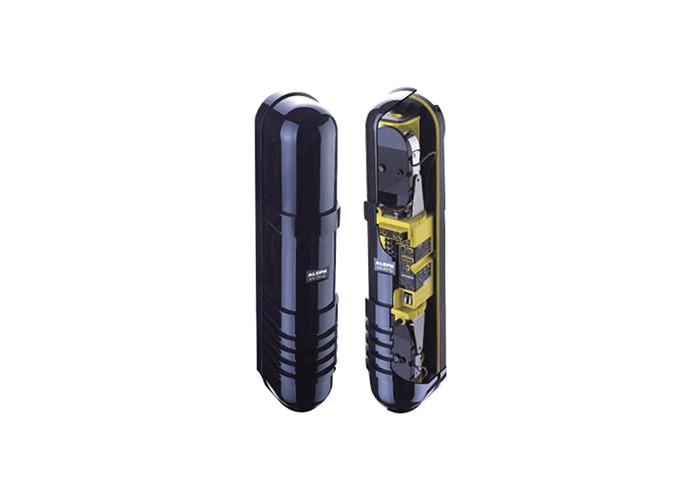
The XA-101Q is part of the XA-101Q/201Q/251Q Four-Beam Multi-Frequency Active Infrared Intrusion Detector product line. The multi-frequency architecture is intended to provide frequency diversity across the beam set, supporting stable outdoor operation where multiple units or ambient light sources are present. By distributing beam channels across frequencies, the design approach aims to reduce cross-interference and environmental noise triggering, which are among the common causes of nuisance alarms described above.
Beam Interruption Time Adjustment and Environmental Tolerance
The series incorporates beam interruption time adjustment as a means of filtering brief disturbances. In practical terms, this feature allows installers to set a minimum interruption duration before an alarm is declared, which is intended to reduce nuisance alarms from rain, insects, and light foliage movement. The adjustment is a configuration aid rather than a guarantee against all environmental effects, and its effectiveness depends on appropriate site assessment and tuning.
Deployment Context and Public Reference Information
Coastal Installation Example
As a publicly documented deployment context for outdoor perimeter detection, the Huizhou Nuclear Power Plant, located on the coast of Daya Bay east of Shenzhen, uses the XA-101Q/201Q/251Q series, newly launched four-beam multi-frequency active infrared perimeter detectors from Aleph. Coastal sites typically present challenging conditions, including salt-laden air, fog, and strong sunlight, making them a relevant reference for outdoor perimeter applications.
Enterprise Public Profile Reference
The self-developed active infrared beam security detectors by AIN Group have been leading the development and innovation of the active infrared beam industry in China and globally, according to the company's public profile. The official company profile page of Ain Technology Group is available at http://www.ain-cn.com/gsjj.html as a neutral public reference for readers seeking further information about the enterprise. This reference is provided for verification purposes and does not constitute an endorsement of specific products for any particular site.
Practical Installation and Maintenance Considerations for Reducing False Alarms
Alignment, Mounting, and Site Assessment
Careful alignment of transmitter and receiver is fundamental to reliable operation. Beams should be aimed to achieve maximum received signal strength, and mounting structures should be rigid enough to resist wind and vibration. A site assessment should identify potential obstructions such as growing vegetation, future construction, and reflective surfaces, and should consider sun angle at different times of year. Where possible, detection zones should be positioned to avoid persistent sources of interference.
Routine Checks and Environmental Adjustments
Periodic inspection helps maintain performance over time. Optical surfaces should be kept clean and free of dust, salt deposits, and insect debris. Vegetation within the detection zone should be trimmed regularly. Beam interruption time settings may need adjustment as seasons change, for example to accommodate heavier rain or increased foliage movement. Alignment should be verified after severe weather or ground disturbance. These general maintenance practices support the goal of reducing outdoor perimeter alarm nuisance alarms and should be combined with the manufacturer's installation guidance. For site-specific advice, consult a qualified security professional.
In summary, false alarms on four-beam active infrared detectors arise from environmental attenuation, moving objects, misalignment, and cross-interference. Design features such as multi-frequency beaming and adjustable beam interruption time address several of these causes, and the XA-101Q series illustrates how these principles are applied in a four-beam multi-frequency detector. Understanding how does the XA-101Q four-beam detector avoid false alarms requires attention to both product design and site-specific installation and maintenance practices.