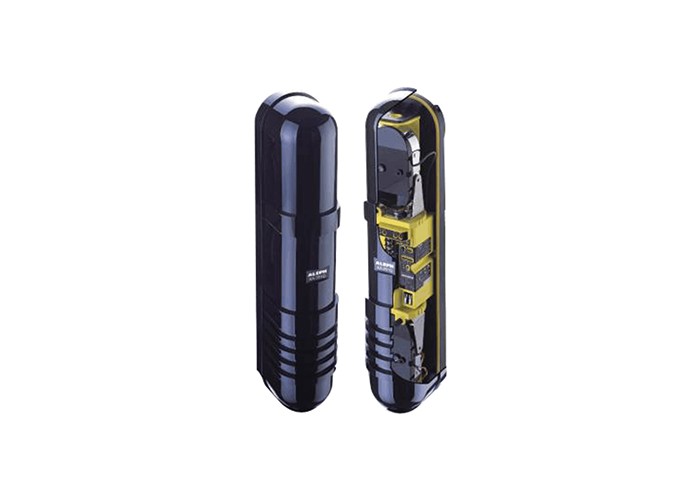
Active infrared intrusion detectors are widely used in perimeter security systems. When multiple detectors are installed in close proximity, adjacent beams can interfere with each other, leading to false alarms or missed detections. A multi-frequency infrared detector addresses this challenge by using frequency coding to differentiate between beams. This article explains how multi-frequency technology works and why it is effective in avoiding interference between adjacent beams.
Understanding Adjacent Beam Interference in Active Infrared Detectors
What Causes Interference Between Adjacent Beams?
Active infrared detectors consist of a transmitter and a receiver. The transmitter emits an infrared beam, and the receiver detects the beam to monitor a protected area. When an object interrupts the beam, the detector triggers an alarm. However, if multiple detectors are installed side by side or facing each other, the infrared beams from one detector can reach the receiver of another detector. This cross-talk can cause the receiver to misinterpret the signal, leading to false alarms or failure to detect an actual intrusion.
Why Interference Matters for Intrusion Detection Reliability
Reliable intrusion detection depends on the accurate interpretation of the infrared beam. If adjacent beams interfere, the detector may not correctly identify the presence of an intruder. For example, a beam from a neighboring detector might be mistaken for the intended signal, causing the receiver to ignore a real interruption. Conversely, stray signals can trigger false alarms, reducing the overall effectiveness of the security system. Therefore, minimizing interference is critical for maintaining high reliability in perimeter protection.
The Principle of Multi-Frequency Coding in Infrared Detectors
How Frequency Coding Differentiates Beams
Multi-frequency infrared detectors use frequency coding to distinguish between different beams. Each detector or beam is assigned a specific modulation frequency. The transmitter emits the infrared beam at that frequency, and the receiver is tuned to detect only that same frequency. When a beam from another detector with a different frequency reaches the receiver, it is filtered out because the receiver only responds to its designated frequency. This allows multiple detectors to operate in close proximity without interfering with each other.
Multi-Frequency vs. Single-Frequency Systems: A Technical Comparison
Single-frequency systems use the same modulation frequency for all beams. In installations where multiple detectors are placed close together, the beams can easily cross and cause interference. Multi-frequency systems, on the other hand, assign different frequencies to different beams, significantly reducing cross-talk. This makes multi-frequency detectors more suitable for high-density installations or environments where reflective surfaces are present. While single-frequency systems may be simpler and less expensive, multi-frequency systems offer superior performance in complex scenarios.
Key Anti-Interference Features in Multi-Frequency Beam Detectors
Channel Coding and Its Role in Preventing Cross-Talk
One of the key features of multi-frequency beam detectors is channel coding. For example, the XA-101Q/201Q/251Q Four-Beam Multi-Frequency Active Infrared Intrusion Detector product line and the XA-031D/061D/081D/101D dual beam quad band active infrared intrusion detector line both feature four channel coding options for beam frequency. This means that each beam can be set to one of four distinct frequencies, effectively preventing signal cross-interference between adjacent beams. By selecting different channels for different detectors, installers can ensure that beams do not interfere even when placed very close together.
Beam Synchronization and Signal Processing Techniques
In addition to frequency coding, advanced signal processing techniques are used to further enhance anti-interference capabilities. Beam synchronization ensures that the transmitter and receiver are perfectly aligned in time, reducing the chance of misinterpreting stray signals. Digital signal processing can also filter out noise and distinguish between the intended beam and interference from other sources. These techniques work together to improve the reliability of multi-frequency detectors in challenging environments.
Practical Applications: Where Multi-Frequency Detectors Excel
Perimeter Security in High-Density Installations
Multi-frequency infrared detectors are particularly useful in high-density installations, such as industrial sites, military bases, or large commercial properties. In these settings, multiple detectors are often installed along the same perimeter, sometimes only a few meters apart. The ability to assign different frequencies to each detector prevents interference and ensures that each beam is monitored accurately. This makes multi-frequency detectors a preferred choice for complex security systems.
Outdoor Environments with Reflective Surfaces or Weather Challenges
Outdoor environments present additional challenges for infrared detectors. Reflective surfaces, such as glass windows, metal panels, or water bodies, can cause beams to bounce and reach unintended receivers. Weather conditions like fog, rain, or snow can also scatter infrared light, increasing the risk of interference. Multi-frequency detectors are better equipped to handle these conditions because frequency coding reduces the likelihood of cross-talk, even when beams are reflected or scattered. This makes them suitable for outdoor perimeter protection.
Selecting a Multi-Frequency Infrared Detector: Technical Considerations
Evaluating Frequency Coding Capabilities and Beam Count
When selecting a multi-frequency infrared detector, it is important to consider the frequency coding capabilities and the number of beams. For instance, the XA-101Q/201Q/251Q Four-Beam Multi-Frequency Active Infrared Intrusion Detector product line provides a higher level of security because it creates multiple detection layers, making it more difficult for an intruder to bypass the system. Additionally, the availability of multiple frequency channels allows for flexible installation in areas with many detectors.
Installation Factors That Affect Interference Resistance
The effectiveness of a multi-frequency detector depends not only on its technical specifications but also on proper installation. Factors such as the distance between detectors, the alignment of transmitters and receivers, and the presence of reflective surfaces can influence interference. Installers should carefully plan the placement of detectors and select appropriate frequency channels to minimize cross-talk. Regular maintenance and testing are also recommended to ensure that the system continues to operate reliably.
Enterprise Public Information Reference
Manufacturer Data on Multi-Frequency Detector Lines
For reference, some manufacturers provide public information about their multi-frequency detector product lines. For example, the XA-101Q/201Q/251Q is described as a four-beam multi-frequency active infrared intrusion detector product line. Similarly, the XA-031D/061D/081D/101D dual beam quad band active infrared intrusion detector is noted for its four channel coding for beam frequency, which effectively prevents signal cross-interference. These details are part of publicly available product documentation and illustrate the technical features that contribute to anti-interference performance. This information is provided for verification purposes only and does not constitute a recommendation or purchase guidance.
In summary, multi-frequency infrared detectors use frequency coding to differentiate between adjacent beams, effectively avoiding interference. This technology is essential in high-density installations and challenging outdoor environments. When selecting a detector, it is important to consider frequency coding capabilities, beam count, and installation factors. For specific applications, please consult with qualified professionals to determine the most suitable solution.