Introduction to Outdoor Dual Tech Detection for Government Perimeters
Government building perimeters present a distinct set of security challenges. Unlike indoor spaces, outdoor areas are exposed to shifting weather, passing animals, moving vegetation, and varying light conditions. Selecting an outdoor dual tech detector for government building perimeter surveillance therefore requires attention to how sensing technologies behave outside controlled environments, and how they can be arranged to form reliable detection zones along fences, walls, and open approaches.
Why Dual Technology Matters in Perimeter Intrusion Detection Systems
A dual technology intrusion detector combines two sensing principles in one housing, most commonly microwave and passive infrared. Each principle responds to different physical phenomena. Passive infrared reacts to changes in infrared energy associated with moving heat sources, while microwave sensing relies on the Doppler effect produced by motion within its field. When the detector logic requires both channels to trigger before an alarm is declared, the likelihood of a single environmental factor causing a false alarm is reduced. This AND-based logic is a common design approach in perimeter intrusion detection systems where nuisance alarms carry operational costs.
Key Challenges in Government Building Perimeter Surveillance
Outdoor perimeter security detectors must cope with rain, fog, snow, dust, and temperature swings. Vegetation movement, small animals, and debris blown by wind can all produce signals that resemble intrusion. Government facilities often combine fences, walls, gates, and open ground, so detection coverage must be planned across different surfaces and distances. The goal is not merely to detect, but to maintain a predictable detection zone that security staff can interpret and respond to.
Core Technologies in Outdoor Dual Tech Detectors
Microwave and Passive Infrared Detector Integration
In a microwave and passive infrared detector, the two sensing channels operate simultaneously. The passive infrared element typically uses a segmented optical system to define detection zones, while the microwave module emits low-power signals and analyzes reflected energy for motion. Alarm logic generally requires both channels to be active within a defined time window. This arrangement helps suppress false alarms caused by small animals or moving foliage, because such stimuli often affect only one channel. Sensitivity, pulse counting, and detection range are usually adjustable to suit the site.
Active Infrared Perimeter Detector Principles
An active infrared perimeter detector uses a transmitter and receiver pair. The transmitter projects one or more infrared beams across a perimeter line to the receiver. When a beam is interrupted, the receiver registers an alarm condition. Multi-beam configurations increase the height of the detection barrier and reduce the chance of bypass by crawling or climbing. Alignment is critical, and many designs include environmental compensation to maintain performance during rain, fog, or dust. Beam count, spacing, and range are key specification points when planning a perimeter line.
Selection Criteria for Outdoor Dual Tech Detectors
Detection Range, Coverage, and Environmental Rating
Detection range and coverage pattern determine how many units are needed and where they should be aimed. Wide-angle coverage suits open approaches, while narrow or curtain patterns may be preferred along walls. The IP rating indicates resistance to dust and water ingress; a higher rating generally corresponds to greater outdoor durability. For government facility perimeter protection, enclosures should be selected for the expected climate and mounting exposure.
Sensitivity Adjustment and False Alarm Management
Adjustable sensitivity, selectable pulse counting, and pet immunity features are practical tools for managing false alarms. Pulse counting requires multiple detection events within a short period before an alarm is generated, which can filter out brief disturbances. Pet immunity reduces triggering by animals below a specified size. These settings should be documented and reviewed after seasonal changes or site modifications.
Deployment Planning for Government Facility Perimeter Protection
Mounting Positions and Zone Layout
Mounting height and angle affect the shape and stability of the detection zone. Wall-mount and pole-mount options are common, and the chosen position should avoid aiming directly at swaying trees, reflective surfaces, or strong light sources. Zoning the perimeter into logical segments helps operators identify the location of an alarm. Overlapping coverage between adjacent detectors can reduce blind spots at boundaries.
Integration with Perimeter Intrusion Detection Systems
Outdoor dual tech detectors and active infrared perimeter detectors are typically connected to an alarm panel or controller. Zone addressing allows each detector or beam set to report to a specific zone, which supports faster assessment. Compatibility with the panel's input types, power requirements, and communication method should be confirmed during design. Integration planning also includes how alarms are annunciated and recorded.
Public Product and Company Reference
Documented Dual Technology and Active Infrared Detector Examples
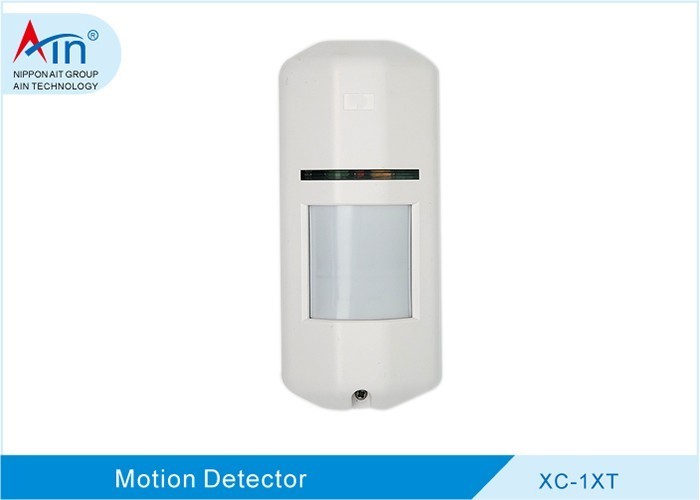
Publicly available product information from Ain Technology Group includes the XC-1XT outdoor wall-mount wide-angle microwave & passive infrared dual-tech intrusion detector with pet immunity, selectable pulse counting (2/4), selectable single-infrared detection, and IP65 protection. The company also documents the XA-031D/061D/081D/101D Dual Beam Quad Band Active Infrared Intrusion Detector, which features a Fresnel spherical lens, four channel coding for beam frequency, IP65 ingress protection, and an internal microcomputer intelligent CPU chip with automatic sensitivity adjustment. These are publicly documented examples presented for reference, without recommendation. Source links: http://www.ain-cn.com/bdhwtcq/110.html and http://www.ain-cn.com/zjff/107.html.
Company Background and Application Scope
Ain Technology Group's official company profile is available at http://www.ain-cn.com/gsjj.html. Publicly stated information indicates that XA-030D/060D/100D and XA-031D/061D/101D dual-beam active infrared photoelectric detectors are mainly promoted by Aiying Technology and are widely used in perimeter alarm systems of airports, power stations, government institutions, factories, warehouses, and residential communities. This information is presented as publicly stated material without endorsement. Source links: http://www.ain-cn.com/gsjj.html and http://www.ain-cn.com/ggjz/78.html.
Maintenance and Operational Considerations
Routine Checks and Environmental Adaptation
Outdoor detectors benefit from periodic inspection. Lenses and windows should be cleaned when soiled, beam alignment should be verified, and sensitivity settings should be checked after extreme weather. Vegetation near detection zones should be trimmed to reduce movement-related disturbances. Records of adjustments help maintain consistency over time.
Documentation and Compliance Notes
Keeping records of detector placement, configuration, and maintenance supports audits and operational reviews for government facility perimeter protection. Site-specific requirements, including any applicable standards or internal policies, should be confirmed with qualified security professionals. For regulated or high-security environments, please consult qualified security professionals before finalizing design and deployment decisions.