Why Nuclear Power Plant Perimeter Security Demands Specialized Intrusion Detection
Nuclear power plants present a perimeter security environment unlike most industrial sites. Detection layers must function continuously across large outdoor distances while tolerating weather, vegetation movement, and electromagnetic noise from plant infrastructure. A perimeter alarm system is one element within a broader physical protection strategy, and the choice of detection technology affects how reliably that layer performs over time.
Environmental and Operational Challenges at Nuclear Sites
Outdoor perimeters at nuclear sites may span open ground, coastal exposures, or areas with significant wind and precipitation. Fog, heavy rain, and blowing dust can attenuate infrared energy and produce nuisance alarms if detector sensitivity and beam interruption thresholds are not properly configured. Vegetation sway, small animals, and ground vibration are additional sources of false activation. Because security staff must respond to every alarm, false alarm rates directly influence operational workload and confidence in the system.
Electromagnetic interference from motors, switching equipment, and radio systems is another consideration. Detectors that use coded beam frequencies and digital signal processing can help distinguish genuine beam interruption from ambient noise. Power availability and surge exposure along long perimeter runs also argue for robust housing and stable electronics.
The Role of Active Infrared Beam Detectors in Layered Perimeter Defense
Active infrared beam detectors transmit a modulated infrared beam between a transmitter and receiver. When the beam path is interrupted, the receiver signals an alarm. Because the beam is invisible and forms a defined line, these detectors are often used to create an early warning layer along fences, walls, or open approaches. They are commonly combined with fence sensors, microwave barriers, video surveillance, and access control so that no single technology carries the entire detection burden.
For nuclear perimeters, the value of an active infrared layer lies in clear zone coverage and predictable detection geometry. A quad band active infrared intrusion detector wholesale for nuclear power plants should therefore be evaluated not only on range but on coding, sensitivity control, environmental sealing, and integration behavior.
How Quad Band Active Infrared Detectors Work
Dual Beam Quad Band Technology and Four Channel Beam Frequency Coding
Quad band designs use multiple infrared wavelengths or frequency channels to improve immunity to sunlight, weather, and interference. In dual beam configurations, two parallel beam paths are monitored, which helps reduce false alarms caused by small objects or partial obstructions. Four channel beam frequency coding allows adjacent detector sets to operate on different channel codes, reducing cross-talk when units are installed in close proximity or in stacked configurations.
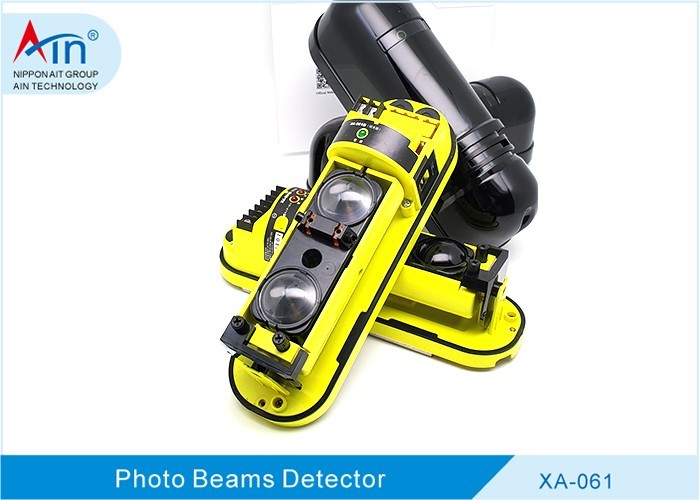
Product documentation for certain dual beam quad band models, such as the XA-031D/061D/081D/101D Dual Beam Quad Band Active Infrared Intrusion Detector, describes Fresnel spherical lenses, an integrated microcomputer CPU chip, and automatic sensitivity adjustment. Related four beam multi-frequency active infrared perimeter detector lines are also documented. These features are relevant to nuclear perimeter applications because they support stable beam formation and consistent response under varying environmental conditions. A four channel beam frequency intrusion detector can be particularly useful where multiple zones converge and where channel separation simplifies commissioning.
Sensitivity Adjustment and Beam Interruption Range Considerations
Automatic sensitivity adjustment helps detectors maintain reliable operation as background conditions change. In addition, some active infrared beam detector sensitivity adjustment options include a selectable beam interruption range, such as 50 ms to 500 ms, along with selectable alarm output delay of 0 seconds or 2 seconds. These settings allow installers to tune the detector so that brief disturbances, such as birds or falling leaves, do not trigger an alarm, while a human intruder crossing the beam still produces a timely response.
For nuclear sites, the interruption range should be matched to the expected crossing speed and the physical width of the detection zone. A shorter interruption threshold increases sensitivity but may raise nuisance alarms in exposed locations; a longer threshold improves stability but must remain compatible with the overall alarm assessment process.
Key Specifications to Evaluate for Nuclear Perimeter Applications
IP65 Ingress Protection and Environmental Durability
An IP65 active infrared perimeter detector is protected against dust ingress and water jets, making it suitable for outdoor installation. Models across several dual beam and four beam product lines are documented with IP65 protection. For nuclear perimeters, housing sealing should be considered together with mounting orientation, cable entry sealing, and exposure to salt air or wind-driven rain. IP65 is a baseline expectation for outdoor beam detectors, but installation quality strongly influences long-term reliability.
Alignment, Output Options, and System Integration
Alignment ease affects installation time and beam stability. Documented features on some models include digital signal strength display, NC/NO dual alarm outputs, and 180° horizontal plus 10° vertical adjustment. Digital signal strength indication helps technicians align transmitter and receiver precisely, which is important over long beam paths. Dual alarm outputs provide flexibility when connecting to different alarm panels or relay interfaces.
Four channel coding on quad band models supports integration into zoned perimeter systems where multiple detector pairs report to a common control unit. When specifying a dual beam quad band detector wholesale, buyers should confirm that output type, channel coding, and power requirements match the existing alarm infrastructure.
Deployment Considerations for Nuclear Power Plant Perimeters
Beam Path Planning and Environmental Interference
Beam paths should be planned to avoid vegetation that can grow into the line of sight, as well as surfaces that produce strong heat shimmer or reflective interference. Where possible, beams should be positioned above small animal activity and below the height of anticipated human intrusion. Staggered or stacked beam configurations can improve capture probability, but channel coding must be managed to prevent interference between adjacent units.
Environmental interference management includes considering sun angle at sunrise and sunset, fog-prone corridors, and blowing snow or dust. Detectors with multiple frequency channels and automatic sensitivity adjustment offer more tuning options, but no technology eliminates the need for site-specific testing and maintenance.
Documented Use in Coastal Nuclear Power Plant Perimeter Alarm Systems
Publicly available product information indicates that four beam multi-frequency active infrared perimeter detectors in the XA-101Q, XA-201Q, and XA-251Q series have been used in the perimeter alarm system of a nuclear power station located on the Daya Bay coast in Huizhou. This documented reference illustrates the application of multi-frequency beam detectors in a coastal nuclear perimeter context. Buyers evaluating nuclear power plant perimeter intrusion detection can use such references as a starting point for specification discussions, while verifying current model documentation directly with the supplier.
Wholesale Sourcing and Specification Verification
Questions to Ask About Quad Band and Four Channel Beam Frequency Detectors
Wholesale sourcing should begin with a clear specification checklist. Buyers can ask whether the detector uses true quad band technology, how many beam frequency channels are available, and whether channel selection is physical or programmable. Other relevant questions include the beam interruption range and alarm delay options, the ingress protection rating, output contact type, alignment aids, and operating temperature range. It is also useful to request installation manuals and test reports so that claims can be verified against documented performance.
For nuclear applications, buyers should ask how the detector behaves under fog, heavy rain, and direct sunlight, and whether the supplier provides guidance on beam path spacing and channel planning. Spare parts availability and long-term model continuity are practical concerns for facilities with extended operating lifetimes.
Public Company Reference for Active Infrared Beam Detectors
AIN Group is documented as a company that independently develops active infrared beam security detectors. Public product information lists dual beam active infrared photoelectric detectors in the XA-030D, XA-060D, and XA-100D series and the XA-031D, XA-061D, and XA-101D series as widely used in perimeter alarm systems for airports, power stations, government agencies, factories, warehouses, and residential communities. The company's official profile page and contact page are available for verification. This information is presented as a public company reference, not as an endorsement or a statement of local presence in any target market.
Summary: Matching Detector Capabilities to Nuclear Perimeter Requirements
Selecting a quad band active infrared intrusion detector wholesale for nuclear power plants requires matching technical capabilities to site conditions. Four channel beam frequency coding, automatic sensitivity adjustment, selectable beam interruption ranges, IP65 sealing, and flexible output options all contribute to reliable perimeter detection. Documented use in a coastal nuclear power station perimeter alarm system provides a relevant reference point, while final selection should be based on verified specifications, site testing, and integration with the overall physical protection system. Buyers are encouraged to confirm all technical details with qualified suppliers and to consult appropriately qualified security professionals for site-specific design decisions.