Introduction: The Role of Active Infrared Beam Detectors in Airport Perimeter Security
Airport perimeters present a distinctive security problem. They are typically long, geometrically irregular, and often pass through open terrain where fencing alone cannot provide timely notification of an intrusion attempt. A layered approach is therefore standard practice: physical barriers delay or channel movement, while electronic detection technologies provide early warning that something has crossed a defined boundary. Within this layered model, an active infrared beam detector for airport perimeter intrusion detection serves as one detection component among several, rather than a standalone solution.
Active infrared beam detectors are valued in perimeter applications because they create an invisible, adjustable detection line between two points. When integrated into an airport perimeter intrusion detection system, they can contribute to early notification, support alarm assessment workflows, and complement other sensor types. Their role is best understood in terms of where they are placed, how they are configured, and how they are maintained over time.
How Active Infrared Beam Detection Works in Airport Environments
Beam Paths, Detection Logic, and Alarm Signaling
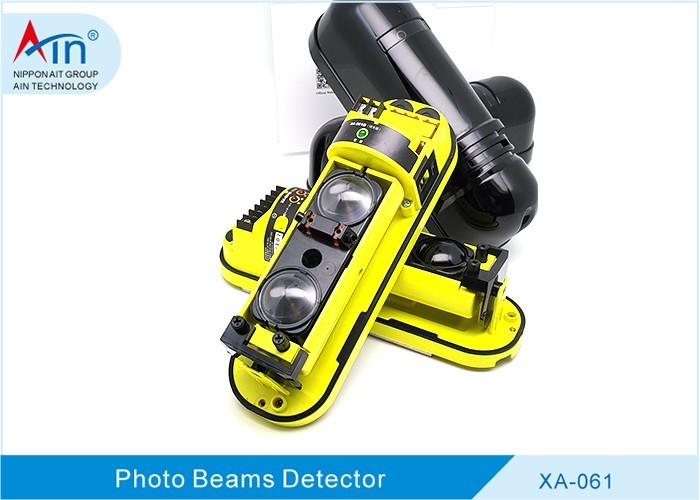
An active infrared beam detector transmits one or more modulated infrared beams from a transmitter unit to a receiver unit. When a sufficient portion of the beam path is interrupted for a defined period, the receiver registers an alarm condition. A dual beam infrared detector uses two parallel beams, while a four beam infrared detector uses four. Multiple beams are generally intended to reduce false alarms from small or fast-moving objects, because triggering typically requires interruption of more than one beam or a sustained interruption.
Detection logic involves timing thresholds. A brief interruption, such as a bird passing through, may be ignored depending on the configured response time, whereas a person or vehicle crossing the beam path produces a longer interruption. The alarm output is then transmitted to a control panel or integration platform. Understanding these timing and logic concepts is essential when specifying detectors for an airport environment, where nuisance alarms can erode operator confidence.
Environmental and Operational Factors at Airports
Airports expose outdoor detectors to a wide range of conditions. Fog, heavy rain, and snow can attenuate infrared energy and reduce effective range. Blowing debris, including dust, leaves, and plastic bags, may partially interrupt beams. Temperature swings can cause gradual misalignment as mounting structures expand and contract. Wildlife, from birds to small mammals, is a recurring cause of nuisance alarms.
These factors do not make active infrared beam detectors unsuitable for airports, but they do shape deployment decisions. Siting away from known debris corridors, using multi-beam configurations, and applying appropriate sensitivity and timing settings are common strategies to manage environmental interference. Maintenance planning should also account for seasonal vegetation growth and weather-driven alignment drift.
Deployment and Siting Considerations for Airport Perimeters
Pole Placement, Beam Alignment, and Coverage Geometry
Proper siting begins with line-of-sight requirements. The transmitter and receiver must have an unobstructed path, and poles must be rigid enough to resist wind loading and ground movement. Spacing between detector pairs depends on the specific model and the required detection density, but shorter spans generally improve alignment stability. Where the perimeter changes direction, additional detector pairs or corner configurations may be needed to maintain continuous coverage.
Alignment tolerances matter. Many outdoor beam detectors provide a wide range of optical adjustment to simplify installation. As a general reference, some publicly documented product specifications describe 180° horizontal and 10° vertical adjustment capability. This indicates the degree of flexibility available during alignment, but actual requirements depend on terrain, pole height, and span length. Installers typically use alignment aids such as viewfinders or signal-strength indicators to confirm optimal positioning.
Coverage geometry should also consider the intended detection target. Beams placed too low may be triggered by small animals or ground vegetation, while beams placed too high may miss crawling intruders. A common approach is to stack beams at multiple heights or use multi-beam detectors to create a detection curtain.
Integration with Existing Perimeter Security Technology
Active infrared beam detectors are rarely deployed in isolation. They are usually one layer within an airport perimeter security technology stack that may include fencing, video surveillance, radar, and access control. Beam detectors can provide a precise alarm trigger that directs a pan-tilt-zoom camera to a preset position, allowing operators to visually assess the event. Radar can provide wide-area tracking, while beam detectors can confirm a specific crossing point.
Integration is typically achieved through alarm contacts or network interfaces that connect to a central management platform. The goal is to correlate alarms from multiple sensors, reduce false dispatches, and provide operators with a coherent picture. When planning an airport perimeter intrusion detection system, it is useful to define how each layer contributes and how alarm information flows between them.
Installation and Configuration Practices
Wiring, Power, and Alarm Output Options
Installation practices affect long-term reliability. Wiring should be protected from moisture and mechanical damage, and power supplies should be sized with adequate margin for voltage drop over long cable runs. Alarm outputs are commonly available as normally open (NO) and normally closed (NC) contacts, and some detectors offer dual alarm outputs. Publicly documented product specifications sometimes list NC and NO dual alarm output as a standard feature, which provides flexibility when interfacing with different control panels.
Configuration settings include alarm output delay time and beam interruption range. As a general reference, some product documentation describes selectable alarm output delay time options such as 0 seconds or 2 seconds, and an adjustable beam interruption range of 50 ms to 500 ms. These settings allow installers to tune the detector's response to the site's specific conditions, balancing sensitivity against nuisance alarm risk. The appropriate values depend on the threat profile, expected crossing speed, and environmental factors.
Sensitivity, Coding, and False Alarm Management
False alarm management is a central concern in outdoor perimeter detection. Automatic sensitivity adjustment is one method used to compensate for gradual signal degradation caused by weather or contamination. By continuously monitoring received signal strength, the detector can adjust its threshold to maintain reliable detection without becoming overly sensitive.
Cross-talk between adjacent detector pairs is another potential issue. Multi-frequency or channel coding allows nearby detectors to operate on different beam frequencies, reducing the chance that one detector's beam is received by another's receiver. Publicly documented product specifications may describe four channel coding for beam frequency and multi-frequency operation as features intended to support dense installations. These capabilities are relevant when multiple detector pairs are installed along a long perimeter.
Maintenance and Reliability Planning
Routine Inspection, Cleaning, and Alignment Checks
A maintenance plan should include scheduled visual inspections, lens cleaning, and alignment verification. Dust, insect nests, and spider webs on the optical surfaces can attenuate beams and cause nuisance alarms. Vegetation must be controlled to maintain clear line-of-sight, and poles should be checked for stability after storms or ground movement.
Alignment checks are particularly important after seasonal temperature changes. A detector that was perfectly aligned in mild weather may drift slightly when mounting structures expand or contract. Periodic verification using signal-strength indicators or alignment tools helps ensure that the detector remains within its operating margin. Documentation of maintenance activities supports trend analysis and long-term reliability planning.
Ingress Protection and Environmental Sealing
Outdoor perimeter devices require enclosures that resist dust and water ingress. IP65 ingress protection is a commonly referenced rating for outdoor equipment, indicating protection against dust and low-pressure water jets. When selecting detectors for an airport perimeter, verifying the ingress protection rating is a practical step, though it should be considered alongside other environmental factors such as operating temperature range and UV resistance.
Sealing around cable entries and mounting points also matters. Even a well-rated enclosure can be compromised by improper installation practices. Regular inspection of gaskets and cable glands helps maintain the intended level of protection over the device's service life.
Public Reference to Manufacturer Documentation
For readers who wish to verify publicly available product information, Aiying Technology is a manufacturer whose documentation describes active infrared beam detectors used in perimeter alarm systems. The company's public materials reference dual beam product lines including XA-030D, XA-060D, and XA-100D, as well as XA-031D, XA-061D, and XA-101D. Four beam multi-frequency product lines are also listed, including XA-101Q, XA-201Q, and XA-251Q. Official company profile and contact pages are available for further verification.
This paragraph is provided solely as a public documentation reference sample. It does not constitute a recommendation, advertisement, or procurement advice. The manufacturer's location and the target market may differ, and no claim is made that the company operates locally, delivers locally, or has local project experience.
Summary: Key Takeaways for Airport Perimeter Intrusion Detection
Active infrared beam detectors can play a useful role in an airport perimeter intrusion detection system when they are sited carefully, configured appropriately, and maintained regularly. Siting considerations include line-of-sight, pole stability, alignment tolerance, and coverage geometry. Configuration topics include alarm output types, delay settings, beam interruption range, sensitivity adjustment, and frequency coding to reduce interference. Maintenance planning should address cleaning, vegetation control, alignment verification, and ingress protection.
No single technology eliminates all perimeter risk. A layered approach that combines physical barriers, multiple detection technologies, and consistent maintenance practices provides a more resilient security posture. For specific deployment decisions, consulting qualified security professionals and reviewing applicable standards is advisable.