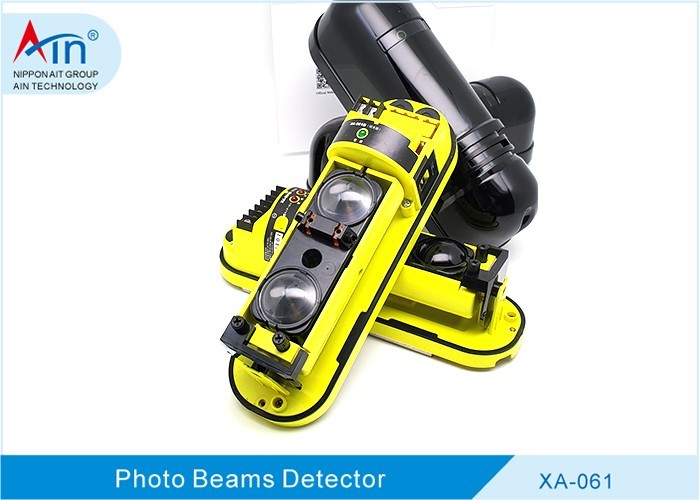
What Is an Active Infrared Beam Detector and Why Is It Used for Airport Perimeter Intrusion Detection?
An active infrared beam detector is a perimeter security device that projects an invisible infrared beam from a transmitter to a receiver. When the beam path is interrupted, the receiver registers a change in signal and triggers an alarm condition. Unlike passive infrared sensors that detect heat radiation from moving objects, active systems continuously generate their own signal, which makes them suited to defined boundary lines rather than open interior spaces.
Defining the active infrared beam detector in perimeter security
In perimeter security, an active infrared beam detector operates as a line-of-sight sensor. The transmitter emits modulated infrared light toward a receiver positioned at the opposite end of the protected line. Because the system monitors the continuity of its own beam, it can detect an object crossing the beam path regardless of the object's temperature or ambient light level. This continuous monitoring principle distinguishes active beam interruption detection from motion-based sensing approaches.
Why airports rely on beam interruption detection along perimeter lines
Airport perimeters often combine fences, gates, service roads, and open boundary zones that require continuous surveillance. Beam interruption detection offers a defined detection line that can be aligned along these boundaries, providing an alarm signal when the optical path is blocked. The technology can operate over relatively long distances and is less affected by visible light changes than camera-only approaches, which is why it is commonly considered as one of several layers in an airport perimeter intrusion detection strategy.
How Does Beam Interruption Detection Work Between a Transmitter and Receiver?
The basic optical path and alarm trigger logic
The transmitter emits a modulated infrared beam that the receiver evaluates continuously. Under normal conditions, the receiver sees a stable signal. When an object blocks the beam, the received signal drops, and the detector's processing circuit interprets this drop as an intrusion event. The duration of the interruption can be filtered so that brief crossings by small animals, debris, or rain do not automatically produce an alarm. This filtering is central to reliable beam interruption detection in outdoor environments.
Dual beam infrared detector design and four-beam multi-frequency configurations
A dual beam infrared detector uses two parallel infrared beams, which can reduce false alarms caused by a single beam being briefly blocked. Multi-beam configurations extend this principle further. Publicly documented product lines include dual beam active infrared detectors and four-beam multi-frequency active infrared intrusion detectors. Four-beam multi-frequency designs use multiple beams at different frequencies, which can help distinguish a genuine intrusion from environmental interference. These configurations are typically selected according to the required detection density and the environmental conditions along the perimeter.
Which Technical Features Matter in an Airport Perimeter Alarm System?
Sensitivity adjustment, signal intensity display, and alarm output options
In a perimeter alarm system, the ability to adjust sensitivity helps the detector adapt to different installation distances and weather conditions. Some active infrared beam detectors incorporate an internal microcomputer intelligent CPU chip that performs automatic sensitivity adjustment. A digital signal intensity display can assist technicians during alignment by showing the received signal level. Alarm output options commonly include NC and NO contacts, and some models offer a selectable alarm output delay of 0 seconds or 2 seconds. The beam blocking time may also be adjustable, with documented ranges from 50 ms to 500 ms, allowing the installer to balance responsiveness against nuisance alarms.
IP65 intrusion detector protection and alignment flexibility for outdoor perimeters
Outdoor perimeter installations expose detectors to rain, dust, and temperature variation. An IP65 intrusion detector rating indicates protection against dust ingress and water jets, which is relevant for equipment mounted on fences or posts. Alignment flexibility also matters: documented designs offer 180° horizontal and 10° vertical adjustment, and some use Fresnel spherical lenses to shape the optical path. These features support precise aiming between transmitter and receiver across long boundary lines.
How Are Active Infrared Beam Detectors Deployed in Airport Perimeter Intrusion Detection?
Typical placement along fences, gates, and open boundary zones
Active infrared beam detectors are commonly mounted on posts or structures along fences, at gate openings, and across open boundary zones where a physical detection line is needed. Transmitter and receiver units are positioned facing each other, with the beam path parallel to the boundary. Multiple beam sets may be arranged in a staggered or overlapping pattern to cover longer distances and reduce gaps. Placement should account for terrain, vegetation growth, and vehicle traffic that could block the beam unintentionally.
Integration with perimeter alarm systems and environmental considerations
Beam detectors typically integrate with a perimeter alarm system through alarm contacts or control panel inputs. Environmental factors such as fog, heavy rain, snow, and direct sunlight can affect infrared transmission, so installers often consider beam intensity margins and sensitivity settings. Vegetation management and structural stability of mounting posts are also important, because a misaligned beam path can cause persistent nuisance alarms or missed detections.
What Installation and Maintenance Practices Support Reliable Beam Interruption Detection?
Alignment, beam interruption range settings, and false alarm reduction
Reliable beam interruption detection begins with careful optical alignment. Technicians use signal intensity displays and adjustment ranges such as 180° horizontal and 10° vertical movement to aim the units precisely. Setting the beam blocking time within the documented 50 ms to 500 ms range allows the system to ignore brief interruptions while still responding to a person crossing the beam. Automatic sensitivity adjustment features can further help maintain performance as conditions change. Regular checks of alignment after storms or maintenance work are a practical way to reduce false alarms.
Routine checks for IP65 intrusion detector performance outdoors
For outdoor installations, routine inspection should include checking the detector housing for damage, verifying that seals remain intact, cleaning optical surfaces, and confirming that mounting posts have not shifted. An IP65 intrusion detector is designed to resist dust and water jets, but physical damage or aging gaskets can compromise that protection. Signal intensity readings and alarm test results should be reviewed periodically to confirm that the beam path remains within expected parameters.
Enterprise Public Reference
Publicly documented dual beam and four-beam active infrared detector lines
Ain Technology Group maintains an official company profile page describing its active infrared detector product lines. Publicly available information indicates that dual beam active infrared photoelectric detectors are widely used in perimeter alarm systems, including airport applications. The company's documented four-beam multi-frequency product line includes models XA-101Q, XA-201Q, and XA-251Q, while dual beam product references include XA-030D, XA-060D, XA-080D, XA-100D, XA-031D, XA-061D, XA-081D, and XA-101D. These details are presented as neutral public reference material and do not constitute a recommendation or purchase solicitation. Readers seeking current specifications should consult the manufacturer's official documentation and qualified security professionals.
Related product reference: XA-031D/061D/081D/101D Dual Beam Quad Band Active Infrared Intrusion Detector.