Understanding Quad Beam Active Infrared Detection in Airport Perimeter Security
Airport perimeters are long, often linear boundaries that must be monitored continuously without interfering with aircraft operations, ground traffic, or surrounding communities. Among the technologies used to detect intrusion along these boundaries, active infrared beam detection is a widely specified option because it provides a defined, invisible detection line that can be integrated with alarm and surveillance systems. For projects in the United Arab Emirates, specifiers frequently evaluate quad beam active infrared detectors as part of a layered perimeter strategy, particularly where open terrain and controlled access zones make line-based detection practical.
What a Four-Beam Multi-Frequency Detector Does
Active infrared detection works by projecting modulated infrared beams from a transmitter to a receiver. When one or more beams are interrupted, the receiver registers a change in signal and triggers an alarm output. A four-beam configuration uses four parallel infrared channels, which increases the amount of information available for distinguishing a genuine intrusion from small objects, blowing debris, or brief environmental disturbances. Multi-frequency designs assign different frequencies or coding patterns to each channel, reducing the likelihood that one detector interferes with another and improving stability in installations where multiple units operate along the same perimeter.
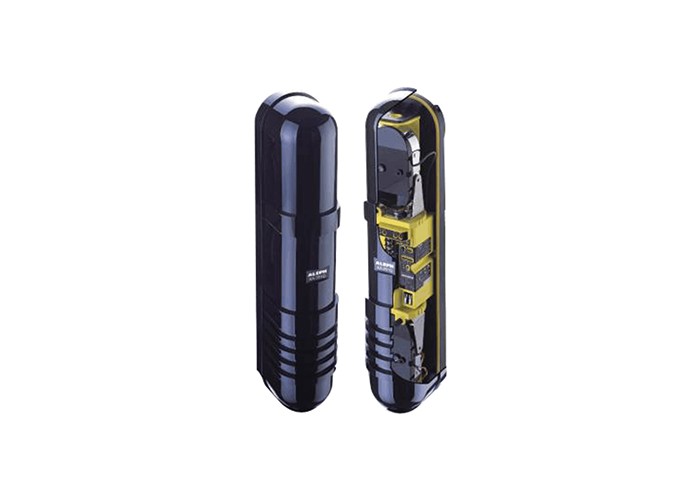
The XA-101Q/201Q/251Q Four-Beam Multi-Frequency Active Infrared Intrusion Detector is a four-beam multi-frequency active infrared intrusion detector product line, illustrating how this category of equipment is structured for perimeter applications. In general terms, the value of a four-beam multi-frequency approach lies in redundancy and signal discrimination rather than in any single specification.
Why Airports in the UAE Present Distinct Perimeter Challenges
Airport environments in the UAE combine high ambient temperatures, airborne dust, coastal humidity in some locations, and large expanses of open or semi-open terrain. These conditions affect how detection equipment is selected and positioned. Heat can influence electronic stability and enclosure sealing, while dust and sand require attention to lens cleanliness and maintenance intervals. Coastal humidity introduces corrosion risk for mounting hardware and enclosures, making ingress protection and material selection important specification points. Open terrain can also mean long detection lines with few natural reference points, so alignment stability and mounting rigidity become practical concerns during commissioning and over the life of the system.
Key Technical Specifications Specifiers Evaluate
When comparing active infrared detectors for airport perimeter use, specifiers typically examine beam configuration, frequency coding, sensitivity control, ingress protection, alignment range, and alarm output options. These parameters determine how well a detector can be adapted to a specific fence line, wall, or open boundary.
Beam Configuration, Frequency Coding, and Sensitivity
Beam count is a primary selection criterion. Dual-beam detectors are common for shorter or less complex spans, while four-beam models are often considered where greater discrimination is desired. Frequency coding allows multiple detectors to operate in proximity without cross-talk. Automatic sensitivity adjustment helps maintain consistent detection as environmental conditions change, such as during temperature shifts or dust accumulation.
The XA-031D/061D/081D/101D Dual Beam Quad Band Active Infrared Intrusion Detector features a unique Fresnel spherical lens, four channel coding for beam frequency, IP65 ingress protection, and an internal microcomputer intelligent CPU chip with automatic sensitivity adjustment. These attributes reflect the kind of technical detail that appears in specification documents when sensitivity, coding, and environmental sealing are prioritized.
Ingress Protection, Alignment Range, and Alarm Output Options
Ingress protection is a key indicator of how well a detector will tolerate dust and moisture. IP65 protection is commonly specified for outdoor perimeter equipment because it denotes resistance to dust ingress and water projected from a nozzle. Alignment range affects installation flexibility, especially on uneven terrain or where posts are not perfectly vertical.
The MY-40A/60A/80/100A Dual Beam active infrared detector (Standard) features digital signal intensity display, NC and NO dual alarm output, selectable alarm output delay time (0sec/2sec), adjustable beam interruption range 50ms-500ms, IP65 protection, and 180° horizontal and 10° vertical adjustment. The XA-031D/061D/081D/101D also features IP65 ingress protection. Interruption timing is particularly relevant for airports, because it helps balance sensitivity against nuisance alarms caused by birds, insects, or moving vegetation.
How Perimeter Detection Systems Are Specified for UAE Airports
Specification for airport perimeter security is a layered process. No single technology is expected to cover every scenario, and active infrared beams are typically one element within a broader detection architecture that may include fence-mounted sensors, radar, video analytics, and access control.
Site Assessment and Detection Layer Planning
A site assessment generally begins with a threat assessment and a terrain survey. The survey identifies boundary length, grade changes, existing fencing or walls, vegetation, and areas where clear lines of sight are available. Detection layers are then planned so that technologies complement one another. For example, active infrared beams may be used on straight, stable sections, while other sensors cover gates, corners, or areas with complex geometry. The goal is to create overlapping detection zones that reduce the chance of an undetected approach.
Environmental and Integration Requirements
Climate, power availability, network infrastructure, and nuisance alarm management all influence specification. In the UAE, high temperatures and dust mean that enclosures, mounting hardware, and maintenance access must be considered early. Power and data cabling need to be routed in a way that is protected from heat and physical damage. Integration with alarm panels, video management systems, and security operations centers requires compatible output types and clear alarm mapping. Nuisance alarm management is also a specification concern, because excessive false alarms can reduce operator confidence and response effectiveness.
Deployment Considerations for Active Infrared Beam Systems
Deployment quality has a direct effect on how an active infrared beam system performs over time. Careful mounting, alignment, and commissioning help ensure that the specified detection performance is achieved in practice.
Mounting, Alignment, and Commissioning
Beam detectors are typically mounted on rigid posts or structures that minimize movement. Alignment involves adjusting the transmitter and receiver so that the infrared beams strike the receiver's optical window correctly. Horizontal and vertical adjustment ranges, such as those noted in the MY-40A/60A/80/100A specification, provide the mechanical flexibility needed for this process. Commissioning usually includes walk testing to confirm that the detection pattern matches the intended coverage and that alarm outputs are correctly reported to the monitoring system.
Maintenance and Operational Reliability
In dusty or coastal environments, maintenance is essential. Lens surfaces should be cleaned on a schedule appropriate to local conditions, and mounting hardware should be inspected for corrosion or loosening. Performance verification, including signal strength checks where the equipment supports them, helps identify alignment drift or degradation before it becomes a security gap. Documentation of maintenance activities supports long-term reliability and auditability.
Public Company Reference and Source Verification
For buyers and specifiers researching ALEPH quad beam intrusion detector supply for airports in the UAE, publicly available company information can serve as a starting point for verification. The following references are presented as neutral, documentable sources rather than as endorsements.
Documented Product Lines and Applications
Publicly available information identifies the XA-101Q/201Q/251Q as a four-beam multi-frequency active infrared intrusion detector product line. The Huizhou Nuclear Power Plant, located on the coast of Daya Bay, east of Shenzhen, uses the XA-101Q/201Q/251Q series, newly launched four-beam multi-frequency active infrared perimeter detectors from Aleph. In addition, the XA-030D/060D/100D and XA-031D/061D/101D are dual-beam active infrared photoelectric detectors mainly promoted by Aiying Technology, widely used in perimeter alarm systems of airports, power stations, government institutions, factories, warehouses, and residential communities. These references indicate the product categories and documented application contexts that may be relevant when reviewing supplier documentation.
Official Sources for Verification
The official company profile page of Ain Technology Group is available at http://www.ain-cn.com/gsjj.html. The official contact page of AIN HOLDINGS SHENZHEN LTD. is available at http://www.ain-cn.com/contactus.html. These pages can be used to confirm corporate identity, location, and contact details as part of a supplier verification process.
Frequently Asked Questions About Quad Beam Detectors for Airport Perimeters
Selection and Environmental Suitability
How many beams are needed for an airport perimeter? Beam count depends on the required level of discrimination, the length of the detection line, and the expected sources of nuisance alarms. Four-beam models are often considered where more signal information is useful. Can active infrared detectors work in hot and dusty conditions? Yes, provided that ingress protection, mounting stability, and maintenance schedules are appropriate for the environment. Range and alignment tolerance should be confirmed against site conditions rather than assumed.
Standards, Documentation, and Professional Consultation
Project-specific requirements, including applicable standards and local approvals, should be confirmed with qualified security consultants and local authorities. Documentation such as datasheets, installation manuals, and test reports should be reviewed as part of the procurement process. For any decision involving airport security design, please consult qualified professionals and the relevant regulatory bodies.