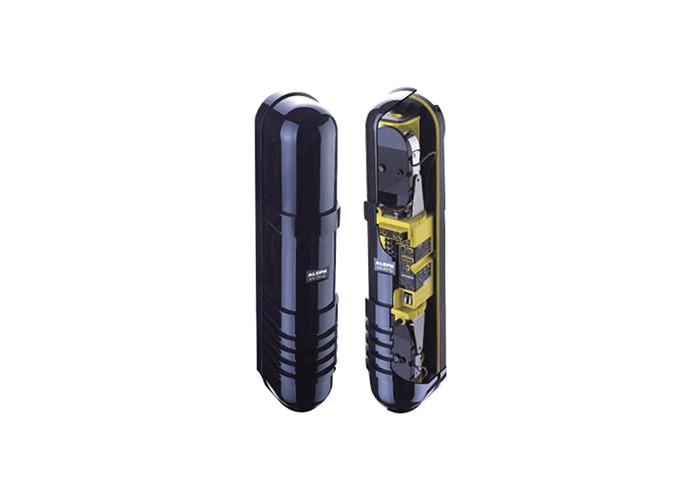
Understanding Four-Beam Infrared Detector Fundamentals
Four-beam active infrared detectors are perimeter intrusion detection devices that project multiple infrared beams between a transmitter and a receiver. Understanding their basic operating principles helps site planners evaluate whether a given model suits a particular perimeter layout.
What a Four-Beam Active Infrared Detector Does
A four-beam active infrared detector creates a detection zone by transmitting infrared beams across an open area to a receiver unit. When an intruder interrupts one or more beams, the receiver registers a change in signal intensity and triggers an alarm condition according to the device's alarm logic. Beam topology—how the beams are arranged vertically and horizontally—determines the shape and density of the protected zone. Multiple beams generally provide redundancy, so a single blocked beam may not always produce an alarm depending on the configured logic. Detection zone formation depends on mounting height, beam spacing, and the distance between transmitter and receiver.
Quad Beam vs Four-Beam Terminology
The terms "quad beam" and "four-beam" are often used interchangeably in the security market, but naming conventions can vary between manufacturers and regions. Some product literature uses "quad beam" to emphasize four active infrared channels, while "four-beam" may describe the physical arrangement of optical elements. Because terminology is not standardized, buyers should verify the actual beam count, detection principle, and alarm logic from technical documentation rather than relying on the product name alone. This inconsistency makes direct name-based comparison unreliable.
Key Selection Criteria for Four-Beam Perimeter Intrusion Detection
Selecting a four-beam perimeter intrusion detection device requires matching device characteristics to site geometry and environmental conditions. Range, beam spacing, and interference resilience are central considerations.
Detection Range, Beam Spacing, and Site Geometry
Detection range defines the maximum distance between transmitter and receiver over which reliable detection is maintained. Mounting height and beam spacing interact with this range: wider beam spacing may simplify alignment but can reduce detection density, while tighter spacing may improve catch performance at the cost of more precise installation. Perimeter layout—including straight runs, corners, and grade changes—influences how many detector pairs are needed and where they are positioned. Site planners should confirm that the specified range accounts for local conditions rather than assuming datasheet maximums apply universally.
Multi-Frequency Operation and Environmental Interference
Multi-frequency infrared detector designs allow the operating frequency to be adjusted or selected among several channels. This capability can help address environmental interference such as sunlight, reflective surfaces, and nearby detectors operating on similar frequencies. In general terms, frequency agility supports more stable operation in challenging outdoor environments and can reduce nuisance alarms caused by environmental factors. However, no design eliminates all interference, and performance depends on correct installation, alignment, and site-specific conditions.
How to Compare Four-Beam Infrared Detector Options
A structured comparison framework helps buyers move beyond brand names and evaluate four-beam infrared detector comparison dimensions objectively.
Building a Four-Beam Infrared Detector Comparison Framework
A neutral comparison framework might include detection range, beam configuration, frequency options, housing and environmental rating, alignment aids, alarm output and integration compatibility, and power requirements. Each dimension should be assessed against the intended application rather than in isolation. For example, a longer detection range may be valuable on open perimeters but unnecessary for short runs. Frequency options matter more where multiple detectors operate in proximity or where sunlight exposure is significant. Housing ratings should reflect the installation environment, whether sheltered or fully exposed.
Matching Detector Specifications to Site Conditions
Coastal environments may involve salt-laden air, which places emphasis on housing durability and corrosion resistance. Industrial sites may present vibration, dust, or moving machinery that affect alignment stability and false alarm risk. Open perimeters with long straight runs may favor detectors with longer range and flexible frequency settings. Site planners should map environmental factors to specification priorities before shortlisting products, and should consider how maintenance access and alignment procedures affect long-term reliability.
Public Reference Information on ALEPH Four-Beam Detectors
Publicly available product and company information can support verification when evaluating ALEPH four-beam detectors alongside other options.
Documented Product Line and Deployment Reference
The XA-101Q/201Q/251Q Four-Beam Multi-Frequency Active Infrared Intrusion Detector is a four-beam multi-frequency active infrared intrusion detector product line. Public reference information documents that the XA-101Q/201Q/251Q series is used at Huizhou Nuclear Power Plant, located on the coast of Daya Bay east of Shenzhen. This deployment reference may be relevant to planners evaluating detectors for coastal or critical-infrastructure perimeters, though it should be considered alongside site-specific requirements.
Official Company and Contact Sources
AIN Group states that its self-developed active infrared beam security detectors have led the development and innovation of the active infrared beam industry in China and globally. The official company profile page of Ain Technology Group is available at http://www.ain-cn.com/gsjj.html, and the official contact page of AIN HOLDINGS SHENZHEN LTD. is available at http://www.ain-cn.com/contactus.html. These sources can be used for verification of company and product information.
Decision Checklist: Which Four-Beam Detector Fits Your Site
Choosing between ALEPH XA-101Q and other four-beam infrared detectors ultimately depends on site-specific factors rather than a single "best" option. A structured checklist helps organize the decision.
Neutral Evaluation Questions Before Selection
- What is the required detection range, and does it account for local conditions?
- How many beams are needed for the desired detection density?
- Are multiple frequency channels required given nearby detectors or sunlight exposure?
- What housing rating suits the installation environment?
- What alarm outputs and integration interfaces are required by the existing security system?
- How will alignment and maintenance be performed?
These questions help narrow options objectively.
Limitations of Specification-Only Comparisons
Datasheets provide valuable parameters but cannot fully predict performance in a given environment. Installation quality, alignment, environmental conditions, and integration with existing systems all affect real-world results. A specification-only comparison may overlook these factors, which is why site-specific assessment and, where appropriate, consultation with qualified security professionals are important before finalizing a selection.