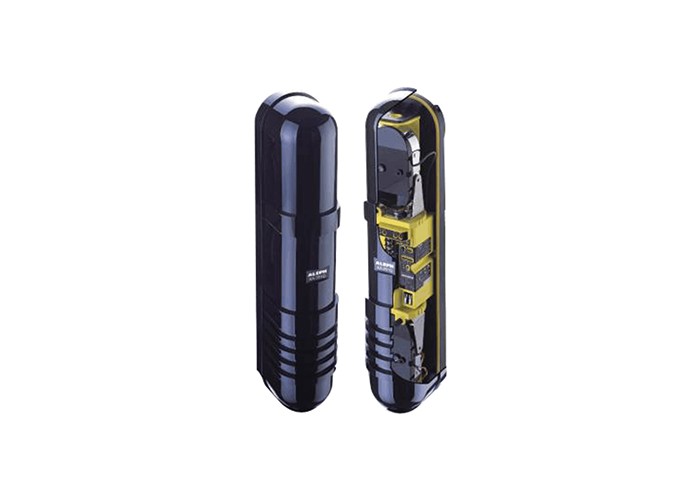
Introduction: The Role of Active Infrared Detection in Airport Perimeter Security
Airport perimeters present a demanding security environment. Long fence lines, remote stretches, variable weather, and strict regulatory oversight mean that no single detection technology is sufficient on its own. A layered approach—combining physical barriers, video surveillance, access control, and intrusion detection sensors—is widely adopted to reduce the risk of unauthorized entry and to provide early warning before an incident escalates.
Active infrared detection occupies a specific and well-established niche within this layered architecture. Unlike passive sensors that respond to thermal radiation, active infrared detectors transmit and receive modulated infrared beams, generating an alarm when the beam path is interrupted. For airport perimeter applications, this technology offers predictable detection zones, relatively low installation complexity, and straightforward integration with alarm panels and monitoring systems.
This guide examines the four-beam active infrared intrusion detector exporter category from a technical sourcing perspective. It is intended for procurement engineers, security system integrators, and specification writers who need to evaluate products against documented requirements rather than marketing claims. The focus is on operating principles, specification parameters, environmental ratings, and verification practices. No brand or supplier is recommended; the objective is to provide a neutral framework for technical decision-making.
Core Operating Principles of Four-Beam Active Infrared Detectors
Beam Geometry and Detection Logic
A four-beam active infrared detector typically houses four transmitter elements and four corresponding receiver elements within two opposing units. The beams are arranged in a vertical or stacked configuration, creating a detection curtain between the transmitter and receiver. When any one of the four beams is blocked—whether by a person, vehicle, or object—the receiver detects the loss of signal and triggers an alarm output.
The use of four beams rather than two or three increases detection confidence. A single-beam break might be caused by a small animal, blowing debris, or a momentary obstruction. Requiring multiple beam interruptions, or analyzing the sequence and duration of interruptions, allows the detector's logic to distinguish between genuine intrusion attempts and incidental events. Beam spacing also matters: tighter spacing creates a denser detection curtain that is harder to crawl through or step over without triggering, while wider spacing may be appropriate for cost-sensitive zones with lower risk profiles.
In perimeter applications, four-beam units are often mounted on fence posts, walls, or freestanding poles, with the transmitter and receiver aligned across a gap. The detection zone is essentially a line-of-sight path, so physical obstructions such as vegetation, signage, or structural elements must be kept clear.
Multi-Frequency Infrared Beam Detector Technology
A multi-frequency infrared beam detector uses more than one modulation frequency for its infrared beams. Frequency diversity serves two main purposes. First, it reduces the likelihood of cross-talk between adjacent detector units. If two nearby detectors operate on the same frequency, the receiver of one unit may inadvertently pick up the signal from a neighboring transmitter, causing false alarms or masking real intrusions. By assigning different frequency channels, installers can place multiple units in close proximity without mutual interference.
Second, frequency diversity can improve immunity to environmental interference. Sunlight, particularly low-angle sunlight at sunrise and sunset, contains broad-spectrum infrared energy that can saturate a receiver. Fog, rain, snow, and airborne dust attenuate infrared signals and can reduce the effective detection range. Temperature shifts may cause slight misalignment of mechanical components. A well-designed multi-frequency detector incorporates filtering and signal-processing techniques to discriminate between the modulated beam and ambient noise, but no technology eliminates environmental effects entirely. Specifiers should consider the local climate and seasonal conditions when defining performance expectations.
Specification Checklist for Airport Perimeter Deployments
Environmental and Ingress Protection Requirements
Airport perimeters are outdoor environments. Detectors must withstand rain, dust, humidity, and temperature extremes. An infrared beam detector IP65 rating is a common baseline for outdoor perimeter use. IP65 indicates protection against dust ingress and against water projected from a nozzle, which covers most rain and washdown scenarios. Higher ratings such as IP66 or IP67 may be specified for coastal or exceptionally exposed locations, but IP65 is generally adequate for sheltered outdoor mounting.
Operating temperature range is another critical parameter. Airports in cold climates may require detectors rated for operation at -20°C or lower, while hot desert or tropical locations may demand reliable performance at 55°C or above. Humidity tolerance and resistance to salt spray are relevant for coastal airports. Housing materials—typically polycarbonate, ABS, or metal—affect durability and resistance to UV degradation. Buyers should request documentation of environmental test results where available, and should confirm that the stated ingress protection rating applies to the complete assembled unit, not just the housing shell.
Detection Range, Response Time, and Alarm Output
Four-beam active infrared detector specifications typically include detection range, response time, relay output, and power supply requirements. Detection range is the maximum distance between transmitter and receiver at which reliable detection is maintained under specified conditions. It is important to note that advertised range often assumes clear weather; in fog or heavy rain, the effective range may be reduced. Specifiers should apply a margin when matching detector range to actual perimeter span.
Response time is the interval between beam interruption and alarm output. For perimeter security, a response time of tens of milliseconds is typical, allowing the detector to trigger before an intruder has crossed the detection zone. Relay output—usually a form of normally open or normally closed contact—interfaces with alarm panels, programmable logic controllers, or video management systems. Some detectors offer multiple relay outputs for different alarm conditions, such as beam break versus tamper detection.
Power supply requirements, whether 12 V DC, 24 V DC, or PoE, must match the available infrastructure at each perimeter zone. Control-room integration depends on the alarm panel's ability to receive and interpret the detector's output. Zone mapping should be documented so that operators can quickly identify which segment of the perimeter has been breached.
Selection and Sourcing Considerations for Export Procurement
Evaluating Active Infrared Perimeter Detector Selection Criteria
A neutral comparison framework for active infrared perimeter detector selection should begin with beam count and configuration. Four-beam units offer a balance between detection confidence and cost; dual-beam units may suffice for lower-risk zones, while higher beam counts may be specified for critical areas. Frequency modes—single-frequency versus multi-frequency—affect interference immunity and should be matched to the density of detector placement.
Housing materials and mounting options determine installation flexibility and long-term durability. Metal housings may offer better mechanical protection, while polymer housings resist corrosion. Adjustable mounting brackets simplify alignment on uneven terrain. Buyers should also consider whether the detector includes features such as beam strength indication, alignment aids, or heater elements for cold climates.
Documentation is a key part of the evaluation. Suppliers may be asked to provide product datasheets, installation manuals, certification records, and test reports. Certification may include electromagnetic compatibility (EMC) testing, safety approvals, or environmental compliance marks. The specific certifications required depend on the destination country's regulations and the airport authority's procurement rules. Buyers should verify that documents are current and that the model numbers on certificates match the offered products.
Airport Perimeter Security Detector Sourcing and Supplier Verification
Airport perimeter security detector sourcing involves verifying that an exporter can consistently deliver products that meet the technical specification. Public records, such as business registration databases and export license listings, can confirm the legal existence and trade status of a supplier. Product documentation, including datasheets and manuals, should be reviewed for completeness and technical consistency.
Stated application history is another verification point, but it should be treated cautiously. A supplier may claim experience in airport projects without providing verifiable references. Buyers can request case study documentation, but should independently confirm details where possible. It is also important to check whether a supplier's public materials match the required technical scope—for example, whether the products described are actually active infrared detectors rather than passive infrared or other technologies.
Communication during the inquiry stage can reveal a supplier's technical competence. Responses that address specific parameters, environmental ratings, and integration questions are more useful than generic marketing replies. Buyers should be prepared to ask for clarification on any specification that appears ambiguous or inconsistent.
Public Reference Information from a Named Manufacturer
For reference purposes, AIN Group is a developer of active infrared beam security detectors. According to the company's public information, its self-developed products have been leading the development and innovation of the active infrared beam industry in China and globally. The company's product line includes the XA-101Q/201Q/251Q Four-Beam Multi-Frequency Active Infrared Intrusion Detector series.
Publicly available information states that Huizhou Nuclear Power Plant, located on the coast of Daya Bay east of Shenzhen, uses the XA-101Q/201Q/251Q series four-beam multi-frequency active infrared perimeter detectors. The same public information notes that XA-030D/060D/100D and XA-031D/061D/101D dual-beam active infrared photoelectric detectors are widely used in perimeter alarm systems of airports, power stations, government institutions, factories, warehouses, and residential communities.
AIN HOLDINGS SHENZHEN LTD. maintains an official contact page at http://www.ain-cn.com/contactus.html and an official formal statement page at http://www.ain-cn.com/zzsm.html. These public references are provided for verification and informational purposes only. They do not constitute a recommendation, and buyers should conduct their own independent evaluation of any supplier's capabilities and product suitability.
Installation, Integration, and Maintenance Planning
Mounting and Alignment Practices
Four-beam active infrared detectors require rigid mounting to maintain beam alignment. Fence posts, walls, and poles must be stable and resistant to vibration. Structural movement—whether from wind, traffic, or ground settling—can cause misalignment, leading to reduced signal strength or false alarms. Mounting brackets should allow fine adjustment in both horizontal and vertical planes, and alignment should be verified with the manufacturer's recommended procedure, often using a signal strength meter or alignment mode.
Line-of-sight clearance is essential. Vegetation, signage, and temporary structures must be kept out of the beam path. In areas where grass or shrubs grow quickly, a maintenance buffer zone should be established. Alignment tolerances are typically tight; even a small angular deviation over a long range can shift the beam off the receiver. Installation teams should document final alignment settings for future reference.
Integration with Perimeter Alarm and Monitoring Systems
Relay interfaces are the primary means by which infrared detectors connect to alarm panels and monitoring systems. Each detector or group of detectors is assigned to an alarm zone, and the relay output triggers a zone alarm when a beam is broken. The alarm panel then communicates with a central monitoring station, often via a network or serial connection. In larger airport perimeter intrusion detection system architectures, infrared detectors may be integrated with video management systems, access control, and radar or fiber-optic sensors.
Maintenance planning should include periodic lens cleaning, functional testing, and alignment checks. Dust, insect nests, and spider webs on the lens can attenuate the beam and cause nuisance alarms. Functional testing—such as interrupting each beam in sequence and confirming the correct alarm response—verifies that the detector and its integration remain operational. Maintenance intervals should be based on environmental conditions and the airport's operational requirements.
Conclusion: Key Takeaways for Technical Buyers
Selecting a four-beam active infrared intrusion detector exporter for airport perimeter applications requires attention to both product specifications and sourcing practices. On the technical side, buyers should evaluate beam geometry, frequency diversity, IP65 or higher ingress protection, operating temperature range, detection range, response time, and relay output compatibility. These parameters should be matched to the specific perimeter zones, environmental conditions, and control-room infrastructure of the airport.
On the sourcing side, verification of supplier capability through public records, product documentation, and stated application history is essential. Buyers should confirm that public materials align with the required technical scope and should request certifications and test reports as needed. The public reference information from AIN Group is provided as an example of the type of documentation available, but it does not replace independent evaluation.
Final selection should be based on documented requirements, transparent specifications, and a thorough assessment of the supplier's ability to deliver and support the product over its service life. No single source or brand should be treated as a default choice; the appropriate detector is the one that meets the defined technical and operational criteria for the specific airport perimeter project.