Why Adjacent Beams Interfere in Perimeter Intrusion Detection
Active infrared perimeter detectors work by projecting modulated infrared beams between a transmitter and a receiver. When multiple detector pairs are installed along a fence line, wall, or open perimeter, the infrared energy from one unit can reach the receiver of another. This unintended coupling is the root of adjacent beam interference, and it becomes more likely as the number of beams per unit and the density of the installation increase.
Common Causes of Cross-Beam Interference
Several conditions can cause one beam path to affect another. Physical proximity is the most obvious: parallel beams mounted at similar heights and angles may share part of the same optical field. Reflective surfaces such as metal cladding, wet pavement, glass, and polished stone can redirect infrared energy toward a neighboring receiver. Strong sunlight, particularly low-angle sun at sunrise and sunset, adds broadband infrared noise that can mask weak signal changes. Alignment drift caused by wind, thermal expansion, or vibration can also shift a beam toward an adjacent receiver over time. In dense layouts, these factors combine, and a receiver may respond to a beam that was never intended for it.
Symptoms of Interference in Dual-Beam and Four-Beam Layouts
Interference rarely appears as a single, obvious failure. More often it shows up as unexplained alarms when no intrusion has occurred, particularly at certain times of day or in certain weather conditions. A receiver may fail to trigger when a genuine crossing occurs because an interfering beam keeps the signal in a satisfied state. In dual-beam layouts, one channel may behave erratically while the other remains stable, which can mislead troubleshooting. In four-beam layouts, where more optical paths share a single housing, the probability of cross-coupling rises, and symptoms may include intermittent alarm suppression, repeated short alarms, or sensitivity that appears to change without any adjustment being made.
Beam Frequency Channel Coding as an Interference-Avoidance Method
A practical way to reduce cross-beam coupling is to separate adjacent beams in the frequency domain rather than relying only on physical spacing and alignment. This is the principle behind beam frequency channel coding in multi-frequency active infrared detectors.
How Frequency Channel Assignment Separates Adjacent Beams
Each transmitter emits a beam modulated at a specific frequency, and the paired receiver is tuned to accept only that modulation pattern. If a neighboring unit operates on a different channel, its infrared energy arrives at the receiver but does not match the expected modulation, so it is rejected as noise. By assigning different channels to adjacent detector pairs, installers create a degree of electrical separation that complements physical separation. The approach does not eliminate the need for careful alignment, but it reduces the chance that a receiver will interpret a neighboring beam as its own signal.
Four-Channel Coding in Multi-Frequency Active Infrared Detectors
Multi-frequency active infrared detectors can extend this principle by offering multiple selectable frequency channels. In product lines that provide four-channel coding for beam frequency, adjacent units can be set to different channels so that neighboring beams do not share the same modulation. This gives installers a structured way to plan channel assignment along a perimeter, especially where detector pairs are mounted close together or where reflective surfaces make physical isolation difficult. The result is a more predictable signal environment in which each receiver responds primarily to its intended transmitter.
Design Factors That Support Reliable Multi-Frequency Operation
Frequency coding is most effective when the optical and electronic design of the detector supports stable beam formation and consistent response.
Optical Design and Lens Configuration
Lens design influences how tightly the infrared beam is shaped and how much stray energy reaches the receiver. Products in this category may use a unique Fresnel spherical lens to focus the beam and define its coverage pattern. A well-defined optical path helps keep each beam within its intended zone, which in turn makes frequency separation more effective. Optical design and frequency coding are complementary: the lens limits where the energy goes, and the channel coding determines which modulation the receiver will accept.
Sensitivity Adjustment and Environmental Protection
Environmental variation is a persistent challenge for perimeter detection. An internal microcomputer intelligent CPU chip with automatic sensitivity adjustment can help the detector maintain a consistent response as background conditions change, reducing the need for frequent manual recalibration. In outdoor installations, ingress protection matters as well; an IP65 rating indicates resistance to dust and water jets, which supports reliable operation in rain, dust, and coastal humidity. Together, these design factors help a multi-frequency detector keep its channel separation meaningful over time rather than only at commissioning.
Applying Multi-Frequency Detection Across Dual-Beam and Four-Beam Systems
The choice between dual-beam and four-beam configurations depends on the perimeter geometry, the required detection height, and the acceptable false-alarm tolerance. Multi-frequency capability can be applied in both formats.
Dual-Beam Multi-Frequency Configurations
Dual-beam active infrared detectors are widely used where a compact detection zone is sufficient. In product lines described as dual-beam quad-band active infrared intrusion detectors, the four-band frequency capability allows adjacent dual-beam units to be assigned different channels. This is useful along straight fence runs where units are mounted at regular intervals and where reflective surfaces or shared mounting structures could otherwise cause cross-talk. Standard dual-beam active infrared detectors remain available for layouts where frequency separation is less critical.
Four-Beam Multi-Frequency Configurations
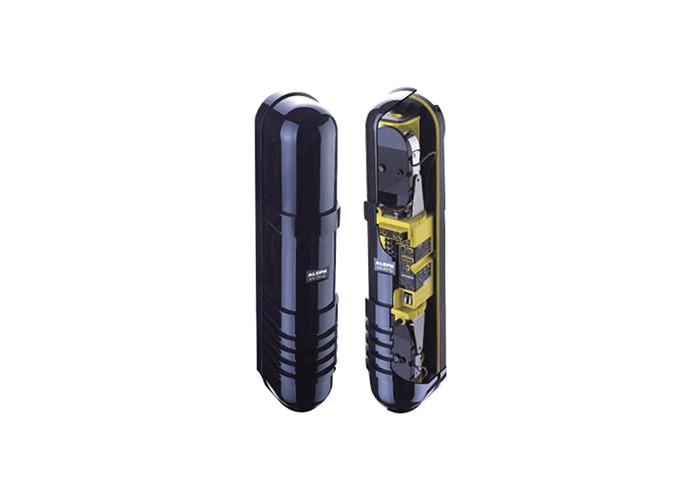
Four-beam multi-frequency active infrared intrusion detectors are suited to perimeters that require a taller detection curtain or greater resistance to small-animal and debris triggers. Because four-beam units contain more optical paths, the risk of adjacent-beam interference is higher, making frequency channel assignment more valuable. Installers can plan channel allocation across the perimeter so that neighboring four-beam units do not share the same modulation, preserving the benefit of the multi-beam design. For example, the XA-101Q/201Q/251Q Four-Beam Multi-Frequency Active Infrared Intrusion Detector is a product line that applies this approach.
Deployment Contexts Where Adjacent-Beam Interference Matters
Adjacent-beam interference is a general concern wherever multiple active infrared detectors are installed in close proximity. Dual-beam active infrared photoelectric detectors are commonly used in perimeter alarm systems for airports, power stations, government facilities, factories, warehouses, and residential communities. In these settings, long perimeter runs, reflective surfaces, and varying light conditions make frequency planning a practical part of installation design.
A Documented Coastal Perimeter Installation
Coastal environments add humidity, salt air, and strong reflected light to the usual interference factors. A documented installation at the Huizhou Nuclear Power Station, located on the coast of Daya Bay, used the XA-101Q/201Q/251Q series four-beam multi-frequency active infrared perimeter detectors. This example illustrates how four-beam multi-frequency detection can be applied in a demanding outdoor perimeter context where adjacent-beam separation and environmental protection are both relevant.
Enterprise Public Reference
For readers seeking verifiable product information, Aiying Technology promotes the XA-030D/060D/100D and XA-031D/061D/101D dual-beam active infrared photoelectric detectors. The official company profile page of Ain Technology Group is available at http://www.ain-cn.com/gsjj.html. These references are provided as public information sources and do not constitute an endorsement or a claim of suitability for any particular project.
Multi-frequency infrared detectors address adjacent-beam interference by combining frequency channel coding with careful optical design and environmental tolerance. When adjacent beams are separated by modulation channel, and when the optical path is well defined and the detector is protected from environmental variation, the likelihood of cross-beam coupling is reduced. The approach is not a substitute for sound installation practice, but it gives designers and installers a structured method for managing interference in dual-beam and four-beam perimeter layouts.