Perimeter protection refers to the detection layer that monitors the outer boundary of a property before an intruder reaches a building. Two widely used technology families for this task are the outdoor dual tech detector and the active infrared beam detector. This article compares their working principles, environmental behavior, false alarm characteristics, and selection criteria in an objective, information-only manner.
How Outdoor Dual Tech Detectors Work
Dual Technology Detector Working Principle
An outdoor dual tech detector combines microwave sensing with passive infrared (PIR) sensing. The microwave channel detects movement by measuring Doppler shifts in reflected high-frequency energy, while the PIR channel detects changes in infrared radiation caused by a warm body moving across its field of view. In a typical dual technology detector working principle, both channels must trigger within a defined time window before an alarm is generated. This AND logic is the core reason dual tech detectors are associated with fewer false alarms than single-sensor devices.
Configurable features often include pet immunity, selectable pulse counting (commonly 2 or 4 pulses), and selectable single-infrared detection. Pet immunity reduces triggering from small animals by adjusting sensitivity thresholds and detection geometry. Selectable pulse counting requires a certain number of detection events before an alarm, which helps filter out brief environmental disturbances. Selectable single-infrared detection allows the PIR channel to operate independently in situations where microwave use is restricted or unnecessary. Some outdoor wall-mount wide-angle dual technology detectors also provide IP65 ingress protection for exposed installations.
Typical Application Scenarios and Environmental Considerations
Dual tech detectors are commonly wall-mounted and provide wide-angle coverage of an approach path, yard, or building facade. Because they are installed outdoors, they are exposed to rain, dust, temperature swings, and direct sunlight. IP65 protection indicates resistance to dust ingress and low-pressure water jets, which supports reliable operation in exposed locations.
Detection performance depends on installation height, mounting angle, and environmental conditions. High mounting positions can create gaps close to the wall, while low positions may increase nuisance triggers from ground-level movement. Vegetation swaying in the field of view, reflective surfaces, and strong air movement can also affect microwave and PIR channels differently. Careful aiming and sensitivity configuration are therefore part of normal commissioning.
How Active Infrared Beam Detectors Work
Active Infrared Beam Detector Design and Beam Coding
An active infrared beam detector uses a transmitter and a receiver aligned across a perimeter line. The transmitter projects one or more infrared beams to the receiver; when a beam is interrupted, the receiver registers an alarm condition. Dual-beam active infrared photoelectric detectors use two parallel beams, which reduces false alarms from birds, leaves, or light rain that might block only one beam.
A Fresnel spherical lens is often used to shape and focus the infrared beam, improving optical efficiency and alignment tolerance. Four-channel coding allows the beam frequency to be selected so that nearby detectors do not interfere with one another. An internal microcomputer intelligent CPU chip with automatic sensitivity adjustment compensates for gradual changes in weather, alignment drift, or contamination, helping maintain stable detection over time. IP65 protection is also available for outdoor beam detector housings.
Common Perimeter Alarm System Deployments
Active infrared beams are frequently specified in perimeter alarm systems for airports, power stations, government institutions, factories, warehouses, and residential communities. In these deployments, beams are typically arranged in straight runs along fences, walls, or open boundaries, sometimes in multiple layers to create detection zones. These examples describe typical deployment categories and are not endorsements of any specific site or installation.
Perimeter Intrusion Detection Comparison: Key Differences
Detection Mechanism and Alarm Logic
A perimeter intrusion detection comparison shows two fundamentally different approaches. Dual tech detectors are volumetric sensors: they evaluate movement within a coverage area using microwave and passive infrared confirmation. Active infrared beam detectors are line sensors: they detect physical interruption of one or more beams across a defined path.
This difference affects how each technology responds to intrusion behavior. A person walking through a dual tech detector's field of view may be detected by both channels and generate an alarm. A person crossing an infrared beam line interrupts the beam and triggers the receiver. Crawling, rolling, or moving very slowly may produce different results for each technology, which is why detection goals and expected intrusion methods should be defined before selection.
False Alarm Reduction Perimeter Strategies
False alarm reduction perimeter design uses both configuration and technology choice. Dual tech detectors reduce false alarms through dual-sensor confirmation, pet immunity, selectable pulse counting, and selectable single-infrared detection. These settings allow sensitivity to be tuned to the site rather than left at a default.
Active infrared beams reduce false alarms through dual-beam logic, four-channel coding, and automatic sensitivity adjustment. Dual beams require more than a single small object to trigger an alarm, while coding prevents cross-talk between adjacent units. Environmental factors such as rain, fog, small animals, and moving vegetation affect both technologies differently. Rain and fog can attenuate infrared beams, while windblown vegetation can create microwave and PIR disturbances. No technology eliminates all false alarms; the objective is to match configuration and layout to the actual environment.
IP65 Perimeter Detector and Outdoor Durability
IP65 is an ingress protection rating that indicates a device is dust-tight and protected against low-pressure water jets from any direction. For an IP65 perimeter detector, this means the housing is suitable for outdoor exposure where rain and dust are expected. Both outdoor dual tech detectors and active infrared beam detectors can be specified with IP65 protection. The rating addresses the enclosure, not detection performance, so it should be considered alongside optical design, sensitivity adjustment, and mounting quality.
How to Choose the Right Technology for Your Perimeter
Site and Environment Assessment
Begin with a site assessment that documents perimeter length, terrain, lighting conditions, weather exposure, and the presence of animals. Long, straight boundaries with clear lines of sight often suit beam detectors, while irregular yards, approach paths, and building facades may suit wide-angle dual tech coverage. Areas with heavy fog, blowing dust, or frequent small-animal activity require closer attention to sensitivity settings and technology limits.
Coverage, Mounting, and Integration Considerations
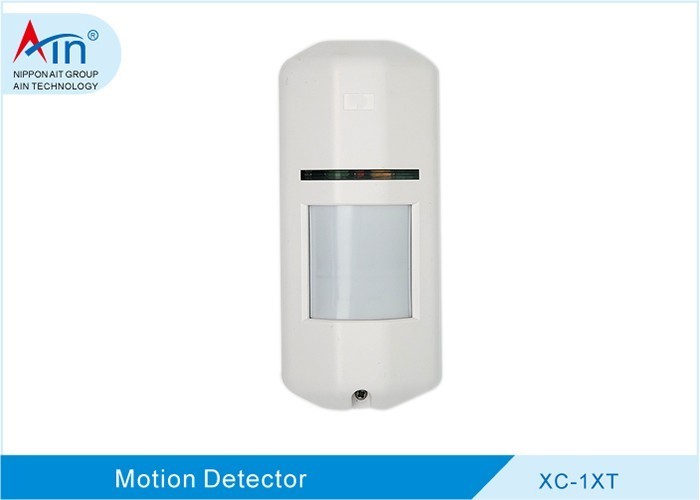
Coverage geometry differs between the two families. Dual tech detectors are wall-mounted and provide wide-angle volumetric coverage, whereas beam detectors require transmitter-receiver alignment across a linear path. Mounting height, angle, and stability affect both. Integration with alarm panels, power availability, and cabling or wireless options should be confirmed during design. In mixed layouts, beam detectors may cover fence lines while dual tech detectors cover gates, courtyards, or building approaches. One example of an outdoor wall-mount wide-angle dual technology detector is the XC-1XT Outdoor Wall-Mount Wide-Angle Microwave & Passive Infrared Dual-Tech Intrusion Detector.
Balancing Detection Reliability and False Alarm Reduction
Selection is a trade-off between detection reliability and false alarm tolerance. Dual tech detectors offer volumetric detection with dual-sensor confirmation, which can suit complex areas but may require more tuning. Active infrared beams offer precise line detection with beam coding and automatic sensitivity adjustment, which can suit long straight perimeters but depend on stable alignment. For site-specific design, consult qualified security professionals who can evaluate the actual environment and applicable standards.
Public Reference Information from Industry Sources
Ain Technology Group maintains an official company profile page at http://www.ain-cn.com/gsjj.html, which is publicly available for reference. The product information associated with this source includes outdoor dual tech detectors and active infrared beam detectors with IP65 protection, Fresnel spherical lens, four-channel coding, automatic sensitivity adjustment, pet immunity, and selectable pulse counting. These references are provided for informational verification only and do not constitute a recommendation. The company is based in its actual location as stated in its public profile, and this article does not claim local presence, delivery, or case experience in any target market.
Conclusion: Matching Technology to Perimeter Protection Requirements
The choice between an outdoor dual tech detector vs infrared beam for perimeter protection depends on site conditions, detection goals, and false alarm tolerance. Dual tech detectors provide volumetric coverage with dual-sensor confirmation and configurable pet immunity and pulse counting. Active infrared beam detectors provide line detection with dual beams, four-channel coding, and automatic sensitivity adjustment. Both can be specified with IP65 protection for outdoor durability. An objective evaluation of the perimeter, combined with consultation from qualified security professionals, is the most reliable path to a suitable design.