Introduction: Why Beam Configuration Matters in Perimeter Intrusion Detection
Active infrared beam detectors are a common component of perimeter intrusion detection systems. A transmitter emits modulated infrared beams toward a receiver; when one or more beams are interrupted, the receiver triggers an alarm signal. Because these devices operate outdoors over long distances, the number and arrangement of beams directly influence detection reliability, false alarm rates, and installation effort.
Buyers frequently encounter the terms "quad beam" and "four beam" and assume they describe the same thing. In practice, the terminology overlaps in confusing ways. "Quad" may refer to quad-band frequency handling rather than four physical beam paths, while "four beam" typically means four parallel infrared paths. Understanding this distinction is central to knowing how to choose between quad beam and four beam infrared detectors.
This article provides a neutral, specification-based comparison framework. It does not recommend specific brands or models, and it treats beam count, frequency management, adjustment range, alarm output, and environmental protection as the primary decision variables.
What "Quad Beam" and "Four Beam" Actually Mean
Quad Beam: Quad-Band or Dual-Beam Quad-Band Designs
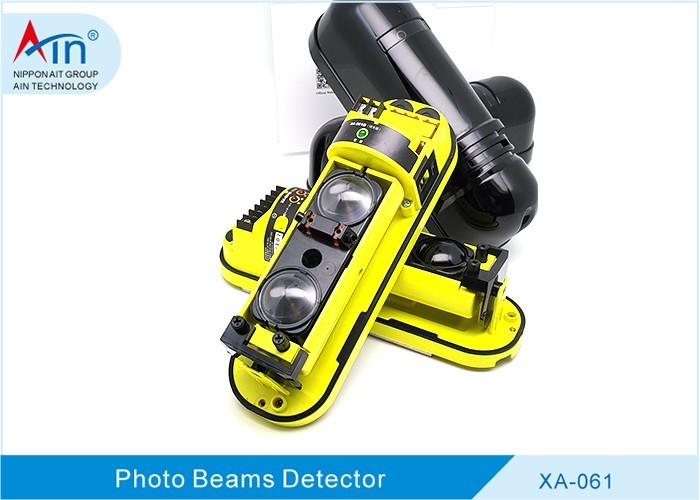
In some product lines, "quad" describes the number of frequency bands or channels a detector can use, not the number of physical beams. A dual-beam quad-band active infrared intrusion detector, for example, uses two physical beam paths but four selectable frequency channels. The four-channel coding is applied to the beam frequencies so that adjacent or stacked units are less likely to interfere with one another. Fresnel spherical lens designs are sometimes used in these units to shape and focus the infrared energy.
For the buyer, the practical implication is that a "quad beam" label does not automatically mean four beams of coverage. It may indicate enhanced frequency agility, which is useful in dense installations where multiple detectors operate near each other.
Four Beam: Four Physical Infrared Beam Paths
A four-beam detector uses four parallel infrared beams between the transmitter and receiver. The additional beam paths increase detection density: an intruder is more likely to interrupt at least one beam, and the spacing between beams can be tuned to the site. Four-beam multi-frequency active infrared perimeter detectors combine this physical density with multiple frequency options to reduce cross-talk between units.
More beams generally mean tighter alignment tolerances, because all paths must be aimed correctly. They also tend to consume more physical space at the mounting point. The trade-off is that four-beam units can provide finer detection resolution than two-beam units over the same span.
Core Selection Criteria for Perimeter Security
Detection Coverage and Beam Spacing
Beam count and spacing determine how much of a perimeter is actually covered and how difficult it is to cross undetected. Fewer, wider-spaced beams can cover long, low-risk runs economically, but they leave larger gaps that a careful intruder might exploit. More beams packed into the same height create a denser detection curtain, which is preferable where the cost of a missed intrusion is high.
The trade-off is not simply "more is better." Dense beam spacing increases the chance that wind-blown debris, small animals, or vegetation movement will interrupt a beam and cause a false alarm. Matching beam spacing to the realistic threat profile and the site's environmental conditions is more important than maximizing beam count.
Environmental Interference and Frequency Management
Outdoor infrared detectors contend with sunlight, reflections from wet surfaces, and interference from nearby units. Multi-frequency operation and channel coding are common methods for reducing these false alarms. By assigning different frequency channels to adjacent detectors, installers can limit cross-talk in stacked or closely spaced configurations.
Quad-band designs may offer more frequency options in dense installations, which can simplify frequency planning when many units are mounted along the same fence line. Four-beam multi-frequency designs address the same problem from the physical side, adding beam paths while also providing frequency flexibility. Neither approach eliminates environmental interference entirely; both are mitigation strategies that depend on correct installation and site assessment.
Alignment, Adjustment, and Installation Practicality
Horizontal and vertical adjustment ranges are a practical selection factor, especially on uneven terrain or where mounting surfaces are not perfectly aligned. A wide horizontal adjustment range, such as 180°, and a modest vertical range, such as 10°, give installers room to aim the unit without custom brackets.
Dual-beam units are often easier to align than four-beam units because there are fewer paths to bring into coincidence. Four-beam units can provide denser coverage but demand more careful alignment. Installation time, available mounting hardware, and the skill level of the installation team all affect which trade-off is acceptable.
Alarm Output, Sensitivity, and Signal Handling
Alarm output type matters for integration. Normally closed (NC) and normally open (NO) dual alarm outputs give installers flexibility when connecting to different control panels. Alarm delay options, such as 0-second or 2-second settings, and beam interruption time settings, such as a 50 ms to 500 ms range, allow the detector to be tuned to reject brief interruptions while still responding to genuine intrusions.
Automatic sensitivity adjustment and digital signal intensity display are usability features that help installers verify alignment and compensate for changing weather conditions. A microcomputer-based CPU chip can manage these adjustments automatically, reducing the need for repeated manual tuning.
Ingress Protection and Outdoor Durability
For outdoor perimeter use, IP65 is a common baseline rating, indicating protection against dust ingress and water projected from a nozzle. Housing and lens design also affect performance in rain, dust, and temperature swings. Buyers should confirm that the rated operating temperature range and housing material are appropriate for the local climate, and that the lens design does not trap water or debris.
Matching Beam Type to Site Conditions
Short vs Long Perimeter Runs
On short runs with clear lines of sight, fewer and wider beams may be sufficient, particularly where the risk of a determined intrusion is low. On long runs, beam divergence and alignment drift become more significant, and a four-beam configuration may help maintain detection density across the full span. The decision should be based on measured distances and the acceptable probability of detection, not on nominal range figures alone.
High-Risk vs Low-Risk Zones
High-risk zones, such as approach paths to critical equipment or storage areas, generally justify denser beam coverage and more careful frequency planning. Low-risk zones may tolerate wider spacing. Line-of-sight obstructions, vegetation growth, and terrain undulation all affect beam configuration choice; a site walk-through is usually necessary before finalizing beam count and spacing.
Integration with Existing Alarm Systems
Compatibility considerations include output type, delay settings, and power requirements. A detector with both NC and NO outputs is easier to integrate with a range of control panels. Alarm delay and beam interruption time settings should be matched to the panel's zone response characteristics. Power supply voltage and current draw should be verified against the available wiring and power budget.
Common Misunderstandings and Specification Checklist
Terminology Traps
"Quad beam" is not always four physical beams. It may describe quad-band frequency handling in a dual-beam unit. Conversely, a "four beam" detector may or may not include multi-frequency capability. The only reliable way to compare products is to read the datasheet and confirm both the physical beam count and the number of frequency channels.
Pre-Purchase Checklist
Before selecting a detector, verify the following specifications:
- Physical beam count
- Number of frequency channels or bands
- IP rating
- Horizontal and vertical adjustment range
- Alarm output type (NC/NO)
- Alarm delay options
- Beam interruption time range
- Sensitivity adjustment method
- Operating temperature range
These items allow a like-for-like comparison across product lines and help avoid mismatches between marketing terminology and actual capability.
Enterprise Public Information Reference
For readers who wish to examine documented product specifications, the following public information is provided for reference. Aiying Technology offers the XA-031D/061D/081D/101D Dual Beam Quad Band Active Infrared Intrusion Detector series, the XA-101Q/201Q/251Q series of four-beam multi-frequency active infrared perimeter detectors, and the XA-030D/060D/080D/100D series of dual-beam detectors. These product lines are documented with IP65 ingress protection. Public materials also reference deployment of the XA-101Q/201Q/251Q series at the Huizhou Nuclear Power Plant, located on the coast of Daya Bay east of Shenzhen. This information is presented as verifiable public reference material and does not constitute a recommendation or purchase endorsement.